Medically reviewed content prepared with a practicing neurology perspective. This article is educational and does not replace a diagnosis from your own doctor.
If you’ve been searching “symptoms of weak nervous system” because you’re dealing with constant fatigue, brain fog, tingling hands, or a body that seems to overreact to every stressor — you’re describing something real, even if the phrase itself isn’t a formal diagnosis. This guide explains what “weak nervous system” actually refers to in medical terms, walks through the real conditions it usually points to, and gives you a clear, step-by-step path for figuring out what’s actually going on and when it’s time to see a specialist.
Understanding the Condition: What Does “Weak Nervous System” Actually Mean?
Here’s the honest answer, upfront: “weak nervous system” is a popular, lay term — not a recognized medical diagnosis. You won’t find it in a neurology textbook or a diagnostic manual. It’s commonly used to describe a cluster of symptoms — fatigue, poor concentration, anxiety, digestive upset, muscle weakness, tingling — that suggest the nervous system isn’t functioning or regulating stress as well as it should.
That doesn’t mean the symptoms aren’t real or worth investigating. In clinical practice, “weak nervous system” complaints usually turn out to be one of a handful of genuine, diagnosable categories:
- Autonomic nervous system dysregulation (dysautonomia) — the “fight or flight” and “rest and digest” systems fall out of balance
- Peripheral neuropathy — actual nerve damage, often from diabetes, vitamin deficiency, or toxin exposure
- Anxiety and stress-related disorders — chronic activation of the stress response affecting sleep, digestion, and concentration
- Nutritional deficiencies — particularly vitamin B12, vitamin D, magnesium, or iron
- Chronic fatigue–type conditions — where nervous system symptoms overlap with persistent exhaustion
- An underlying structural or vascular neurological condition — less common, but this is why persistent symptoms deserve real evaluation rather than lifestyle fixes alone
How Does “Weak Nervous System” Work? The Physiology Behind the Symptoms
our nervous system runs on two main branches that matter here. The central nervous system (brain and spinal cord) processes information and sends commands; the peripheral nervous system carries those signals to and from muscles, organs, and skin. Within the peripheral system, the autonomic nervous system runs things you don’t consciously control — heart rate, digestion, blood pressure, temperature regulation — through its sympathetic (“fight or flight”) and parasympathetic (“rest and digest”) branches.
When people describe a “weak” nervous system, they’re often describing sympathetic overactivation: chronic stress keeps neurons firing in a heightened state, which over time produces measurable downstream effects — elevated inflammatory markers, disrupted sleep architecture, and altered gut motility, since the gut has its own dense nerve network (the enteric nervous system) that’s highly sensitive to stress signaling.
Separately, when actual nerve fibers are damaged — from prolonged high blood sugar, alcohol, chemotherapy, or B12 deficiency — the result is neuropathy, which produces a more specific pattern of numbness, tingling, and burning, usually starting in the feet and hands.
Symptoms of a Weak Nervous System: Types and Categories
General Physical Symptoms
- Persistent fatigue that doesn’t improve with rest
- Muscle weakness or a feeling of heaviness in the limbs
- Numbness, tingling, or a “pins and needles” sensation (classically in hands and feet)
- Dizziness or lightheadedness, especially when standing up quickly
- Digestive issues — bloating, constipation, diarrhea, or nausea
- Headaches or migraines
- Heightened sensitivity to light, sound, or touch
- Tremors or small involuntary movements
Cognitive and Emotional Symptoms
- Difficulty concentrating or “brain fog”
- Memory lapses
- Unexplained anxiety, irritability, or mood swings
- Feeling easily overwhelmed by normal daily stress
- Sleep disturbances — trouble falling asleep, staying asleep, or waking unrefreshed
Red-Flag Symptoms That Are Not “Just Weak Nerves”
These warrant urgent evaluation, not lifestyle changes:
- Sudden weakness or numbness on one side of the body
- Loss of vision, double vision, or slurred speech
- Sudden, severe headache unlike any before
- Loss of bladder or bowel control
- Fainting or loss of consciousness
- Rapidly worsening muscle weakness
Step-by-Step Guide: What to Do If You’re Experiencing These Symptoms
- Track your symptoms for 2–4 weeks. Note frequency, triggers (stress, meals, time of day), and whether symptoms are constant or come in episodes.
- Rule out the fastest-fixable causes first. Ask your doctor for basic bloodwork: vitamin B12, vitamin D, thyroid panel (TSH), fasting glucose or HbA1c, and iron studies. Deficiencies here are common, treatable, and frequently mimic “weak nervous system” complaints.
- Describe the pattern, not just the symptom. Tingling that’s constant and symmetric (both feet) points toward neuropathy; symptoms that spike with stress and ease with rest point toward autonomic/stress-related causes.
- Get a baseline neurological exam if symptoms persist beyond a few weeks despite normal bloodwork — this checks reflexes, strength, sensation, and coordination.
- Ask about autonomic testing (heart rate variability, tilt-table testing) if dizziness on standing, heat intolerance, or digestive symptoms are prominent.
- Seek same-day care for any red-flag symptom listed above — don’t wait to see if it resolves.
Why “Weak Nervous System” Is Often Misdiagnosed or Missed
Three things make this category tricky in real clinical practice:
- The label itself is vague. Because it’s not a formal diagnosis, patients and even some clinicians can stop at a symptom description rather than pursuing the underlying cause.
- Symptoms cross specialties. Fatigue and brain fog get sent to primary care; tingling gets sent to neurology; anxiety gets sent to psychiatry — but the actual cause (say, a B12 deficiency) sits at the intersection and can fall through the cracks if only one specialty is consulted.
- Stress-driven symptoms are easy to dismiss. Patients are frequently told symptoms are “just stress” or “just anxiety,” which is sometimes accurate but is also sometimes a premature conclusion reached before ruling out a treatable physiological cause.
Best Practices for Supporting Nervous System Health
While these aren’t a treatment for an underlying diagnosis, they’re genuinely evidence-supported for autonomic and stress-related symptoms specifically:
- Consistent sleep schedule — irregular sleep is one of the strongest known drivers of autonomic dysregulation
- Regular aerobic exercise — shown to improve heart rate variability and reduce chronic sympathetic activation
- Nutrient-dense diet — adequate B-vitamins, magnesium, and omega-3s support nerve conduction and repair
- Structured stress-management practice — diaphragmatic breathing, mindfulness-based stress reduction, or brief daily relaxation practice measurably lowers sympathetic tone
- Limiting alcohol and stimulants — both directly affect autonomic balance and can worsen neuropathy symptoms
- Social connection — chronic social isolation is independently associated with worse stress-regulation outcomes
Clinical Note: The symptom patients most underestimate is the gut-brain connection. Because the gut has its own extensive nerve network, chronic stress-driven “weak nervous system” symptoms very often show up first as digestive complaints — appetite loss, early fullness, or alternating constipation and diarrhea — well before a patient connects it to stress or anxiety at all. This has a real daily-life cost: patients frequently restrict their diet without realizing it, which can compound fatigue and nutrient deficiency, creating a cycle that’s hard to break without addressing the nervous system component directly rather than just the digestive symptom.
From My Clinical Experience: A Patient’s Journey
“David,” 34, came in after eight months of what he called “my nerves giving out” — persistent fatigue, tingling in both feet, brain fog bad enough to affect his work performance, and a growing sense of anxiety he’d never had before. He’d already seen his primary care doctor twice and been told it was “probably stress” and offered a short course of an anti-anxiety medication, which helped only marginally.
On a more detailed history, it turned out David had switched to a strict vegan diet eighteen months earlier without B12 supplementation — a detail he hadn’t mentioned because he didn’t think it was relevant to how he was feeling. Bloodwork confirmed a significant B12 deficiency alongside mild anemia. His tingling was peripheral neuropathy from nerve damage related to the deficiency, not a primary anxiety disorder — though the fatigue and cognitive symptoms had genuinely worsened his mood and stress levels secondarily.
He started high-dose B12 supplementation, and within six weeks his energy and concentration had noticeably improved. The tingling took longer — about four months — to substantially resolve, which is typical for nerve regeneration. His case illustrates something common in practice: symptoms that get filed under “stress” or “weak nervous system” sometimes have a specific, correctable cause that a broader symptom label can obscure.
Treatment Options: How the Right Approach Is Chosen
There’s no single “weak nervous system” treatment, because there’s no single underlying cause — the right approach depends entirely on what’s actually driving the symptoms.
- Vitamin/mineral repletion (B12, D, magnesium, iron) — First-line when bloodwork shows a deficiency. This is preferred over broader interventions when identified, because it directly reverses the root cause rather than managing symptoms, and improvement is often measurable within weeks.
- Cognitive behavioral therapy (CBT) for anxiety-driven symptoms — Preferred over medication as a first step for many patients because it builds a durable skill set for regulating the stress response, rather than only suppressing symptoms; it’s often combined with medication for moderate-to-severe cases rather than used as an either/or choice.
- Medication (SSRIs/SNRIs, or neuropathic pain agents like gabapentin) — Reserved for cases where symptoms are significantly impairing daily function, or where deficiency-based and behavioral approaches alone aren’t sufficient; the choice between an SSRI/SNRI and a neuropathic agent depends on whether the dominant complaint is mood/anxiety or nerve pain/tingling.
- Autonomic-focused interventions (increased salt/fluid intake, compression garments, structured exercise reconditioning) — Used specifically when autonomic testing confirms dysautonomia, particularly for patients with dizziness on standing.
- Physical therapy — Helpful when muscle weakness or coordination issues are prominent, particularly alongside neuropathy.
The reasoning I walk patients through: if bloodwork shows a clear deficiency, we fix that first and reassess before adding anything else, because treating symptoms on top of an unaddressed root cause often means slower, murkier improvement and unnecessary medication exposure.
Recovery Timeline: What to Realistically Expect
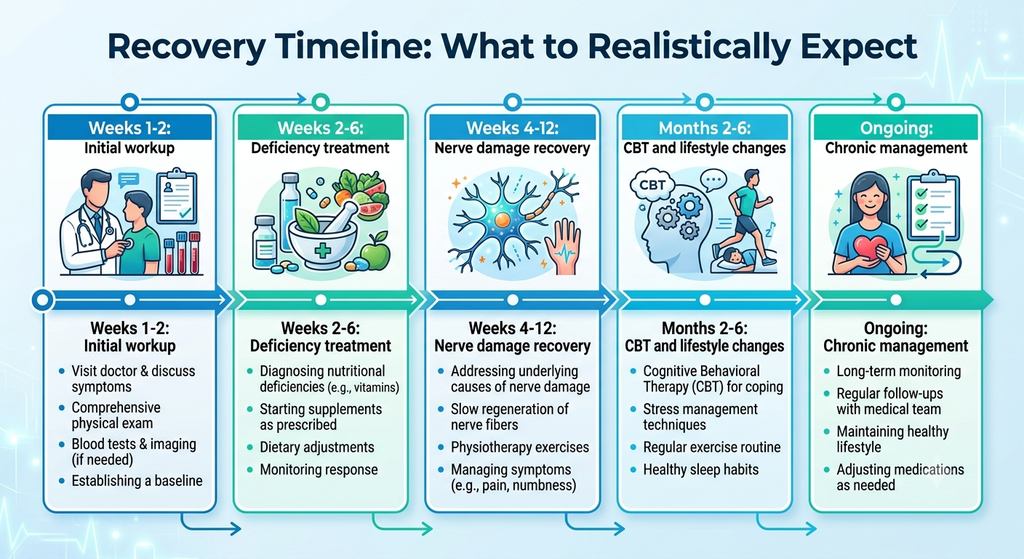
- Weeks 1–2: Initial workup — bloodwork, symptom tracking, baseline neurological exam.
- Weeks 2–6: If a deficiency or thyroid issue is found and treated, many patients notice improved energy and concentration within this window.
- Weeks 4–12: If nerve damage (neuropathy) is present, tingling and numbness typically take longer to resolve than fatigue, since damaged nerve fibers regenerate slowly — improvement over months, not days, is normal.
- Months 2–6: For anxiety- or stress-driven presentations, CBT and lifestyle changes typically show measurable benefit in this window, with continued gains over the following months.
- Ongoing: For chronic autonomic or nerve conditions, management is often long-term rather than a one-time fix — the goal becomes symptom control and functional improvement rather than a fixed “cure” date.
These timelines vary significantly by underlying cause and individual response.
When to Seek Immediate Medical Attention
Don’t wait for a scheduled appointment if you experience:
- Sudden weakness or numbness on one side of the body
- Sudden vision loss, double vision, or slurred speech
- A sudden, severe “worst headache of your life”
- Loss of bladder or bowel control
- Fainting, seizures, or loss of consciousness
- Rapidly progressing muscle weakness
These can indicate a stroke, spinal cord emergency, or other acute neurological event requiring immediate evaluation.
Frequently Asked Questions
References
- Cigna. Nervous System Problems. https://www.cigna.com/knowledge-center/hw/medical-topics/nervous-system-problems-nersp
- ColumbiaDoctors. Nervous System Problems Information & Treatment. https://www.columbiadoctors.org/health-library/symptom/nervous-system-problems/
- Southeast Pain & Spine Care. How a Malfunctioning Nervous System Affects Your Health. https://www.sepainandspinecare.com/how-a-malfunctioning-nervous-system-affects-your-health/
This article is for educational purposes and does not constitute medical advice or a diagnosis. “Weak nervous system” is a popular term, not a formal clinical diagnosis — always consult a qualified healthcare provider about your own symptoms and test results.