Medically reviewed content prepared with a practicing hematology-oncology perspective. This article is educational and does not replace a diagnosis from your own doctor.
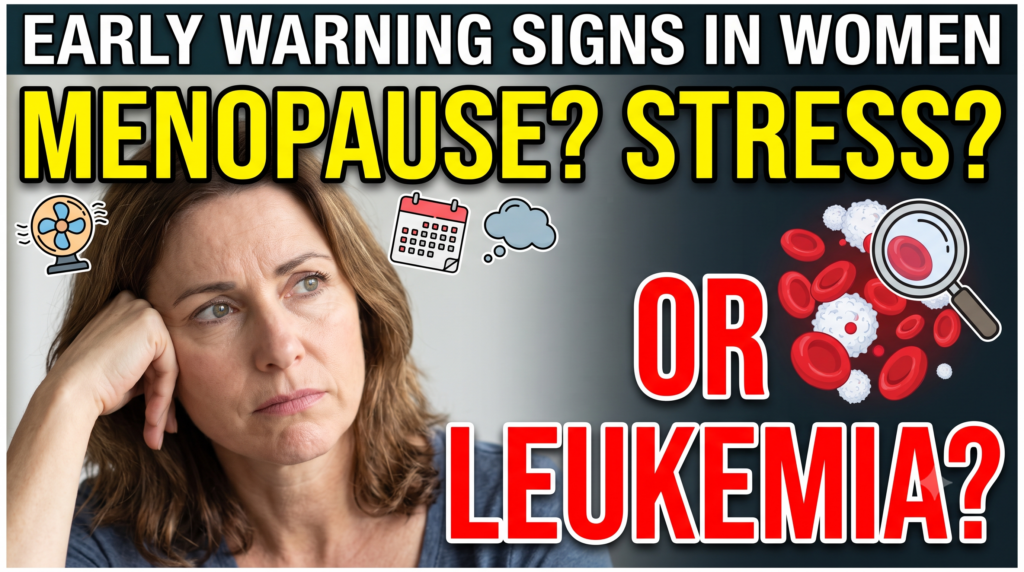
If you’ve been feeling unusually tired, bruising more easily than normal, or dealing with night sweats and heavier periods and you’ve been told it’s “probably just stress” or “probably perimenopause” — you’re not alone, and your instinct to keep asking questions is a good one. Leukemia in women is frequently missed in its early stages precisely because its first symptoms overlap so heavily with ordinary, everyday complaints. This guide walks through what leukemia actually is, how it develops, the specific ways it shows up in the female body, and exactly when a symptom stops being “probably nothing” and becomes something to act on.
What Is Leukemia? Understanding the Condition
Leukemia is a cancer of the blood and bone marrow — the soft, spongy tissue inside your bones where all of your blood cells are made. Leukemia symptoms may include frequent infections, fevers, fatigue, easy bleeding, or bruising, and they vary considerably depending on which type of leukemia is involved and how far it has progressed.
There are four main types, split along two axes — acute (fast-moving) versus chronic (slow-moving), and myeloid versus lymphocytic (which blood cell line is affected):
- Acute myeloid leukemia (AML) — the most common fast-growing adult leukemia
- Acute lymphocytic leukemia (ALL) — more common in children but also occurs in adults
- Chronic myeloid leukemia (CML) — slow-growing, often found incidentally
- Chronic lymphocytic leukemia (CLL) — the most common chronic leukemia in adults
How Does Leukemia Work? What’s Actually Happening in the Body
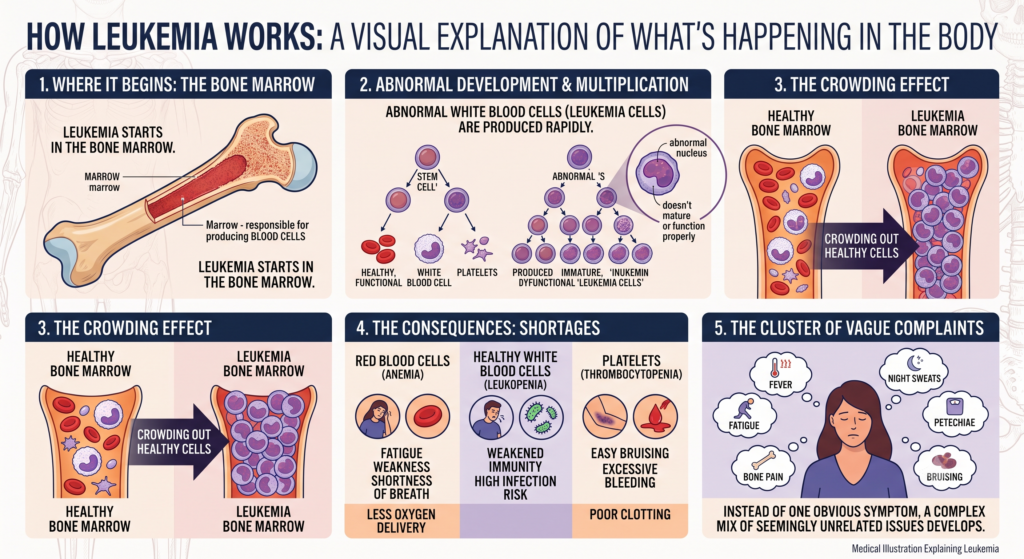
Leukemia begins when the bone marrow starts producing abnormal white blood cells that don’t mature or function properly. As these dysfunctional cells multiply, they crowd out the three things your marrow is supposed to be making in healthy numbers:
- Red blood cells — carry oxygen; a shortage causes anemia
- Healthy white blood cells — fight infection; a shortage (leukopenia) raises infection risk
- Platelets — cause clotting; a shortage (thrombocytopenia) causes easy bruising and bleeding
A low red blood cell count may contribute to weakness, fatigue, or shortness of breath; a low white blood cell count weakens the body’s immune defenses and makes infections more likely; and a shortage of platelets may lead to easy bruising or bleeding. This is why leukemia so rarely announces itself with one obvious symptom — instead, it produces a cluster of vague, seemingly unrelated complaints that build gradually.
Symptoms of Leukemia in Females: Key Details and Facts
General Symptoms That Affect Both Sexes
Most leukemia symptoms aren’t unique to women, but understanding the full list matters because women often experience and report them differently:
- Persistent, unexplained fatigue that doesn’t improve with rest
- Frequent or recurring infections (respiratory, skin, gastrointestinal)
- Easy bruising or bleeding, including nosebleeds or bleeding gums
- Fevers and drenching night sweats
- Unintentional weight loss
- Bone or joint pain, particularly in the legs
- Swollen lymph nodes in the neck, armpit, or groin
- Shortness of breath
- Feeling full quickly after small meals, often from a swollen spleen
These symptoms commonly include fatigue, breathlessness, infections, and bruising or bleeding more easily, and most people who have them will not have leukemia — but the general rule from hematologists is consistent: even a single symptom, if it’s unexplained, persists for a long time, or is unusual for you, is worth a conversation with your doctor.
Symptoms and Presentations That Are Distinct in Women
This is the part that gets under-discussed. While many leukemia symptoms are similar across the sexes, women may experience sex-specific symptoms, and the overlap with normal female biology is exactly what delays diagnosis.
Menstrual changes. This is the clearest female-specific red flag. When leukemia causes thrombocytopenia, women may experience heavy or abnormally long menstruation, and younger patients in particular may notice longer or heavier cycles as platelet counts drop and clotting becomes impaired.
The menopause overlap. According to Dr. Amanda Przespolewski, a hematologist-oncologist formerly of Roswell Park Comprehensive Cancer Center, for women in their 40s and 50s, the signs of leukemia can look a lot like those of menopause. A combination of leukemia symptoms — hot flashes, night sweats, and fatigue — closely mirrors typical menopausal symptoms, which means the disease can hide in plain sight for months.
The combination is the real warning sign. Night sweats and fatigue alone may not seem out of place for a woman going through menopause, but alarm bells should go off when those symptoms appear alongside shortness of breath, feeling full quickly after meals, or unintentional weight loss. Bruising easily, or bleeding heavily from a cut that isn’t healing quickly, is another combination worth flagging — though it’s worth noting these signs can also point toward other, non-cancerous blood conditions that still deserve evaluation.
Clinical Note: In practice, the symptom that most often gets waved off isn’t the bruising or the fatigue on their own — it’s the stacking. A woman who’s tired, has one heavier-than-usual period, and picks up a cold that won’t clear might rationally attribute each symptom to a separate, ordinary cause. It’s the accumulation over two to four weeks, not any single symptom, that should prompt a CBC (complete blood count). This also has a real quality-of-life cost that’s easy to underestimate: the fatigue of early leukemia is often described as different from normal tiredness — it disrupts appetite, makes exercise feel disproportionately hard, and can flatten mood well before a diagnosis is on anyone’s radar, which is part of why patients frequently describe the period before diagnosis as more distressing, in some ways, than treatment itself.
Step-by-Step Guide: What to Do If You Notice These Symptoms
- Track it for two weeks. Because early leukemia symptoms mimic so many common, often harmless conditions like the flu, how long they last matters — if symptoms haven’t improved within two weeks, or keep returning after periods of improvement, it’s time to talk to your primary care doctor.
- Write down the combination, not just one symptom — fatigue plus bruising plus a heavier period is a very different picture than fatigue alone.
- Ask specifically for a CBC (complete blood count) with a differential. This simple blood draw is usually the first test that flags an abnormality.
- Don’t wait out red-flag symptoms. Severe or rapidly worsening symptoms — unusual bleeding or bruising, persistent fever, or shortness of breath — warrant seeking medical attention right away, rather than waiting to see if they resolve.
- If your CBC comes back abnormal, expect a referral to hematology and possibly a peripheral blood smear or bone marrow biopsy to confirm or rule out leukemia.
- Bring a symptom timeline to every appointment. This single habit shortens the diagnostic runway more than almost anything else, because it gives your provider a pattern to react to instead of one isolated complaint.
Why Leukemia Is So Often Misdiagnosed in Women
Three factors compound to delay diagnosis in women specifically:
- Symptom overlap with menopause — hot flashes, night sweats, and fatigue are treated as hormonal by default in women over 40.
- Menstrual symptoms are normalized. A heavier or longer period is often chalked up to perimenopause, stress, fibroids, or diet before a blood disorder is considered.
- Low baseline suspicion. Leukemia symptoms tend to be vague at first and often resemble more common conditions such as the flu, and in early stages there may be no symptoms at all — some cases are only caught through routine blood work done for an unrelated reason.
Risk Factors Worth Knowing
- Age (risk rises with age for most types, though ALL is more common in children)
- Prior chemotherapy or radiation treatment for another cancer
- Certain genetic conditions (e.g., Down syndrome)
- Exposure to high-dose benzene or other industrial chemicals
- Smoking (linked specifically to increased AML risk)
- Family history of leukemia or other blood cancers
It’s worth noting that AML — the most prevalent form of fast-growing leukemia in adults, representing an estimated 80 percent of acute adult cases — is most common in men 65 and older, though it can affect men and women of all ages. This is part of why women’s cases can be underestimated by both patients and providers alike.
From My Clinical Experience: A Patient’s Journey
“Maria,” 47, came in describing eight weeks of fatigue she assumed was perimenopause. She’d also noticed her periods had become heavier and longer than her usual cycle, and she’d had two colds back-to-back that took nearly three weeks each to clear. Her primary care doctor initially attributed the fatigue and night sweats to hormonal changes and suggested lifestyle adjustments.
When the fatigue didn’t budge and she developed unexplained bruising on her shins, she pushed for bloodwork. Her CBC showed a markedly elevated white blood cell count alongside anemia and low platelets — a pattern inconsistent with a hormonal cause. A peripheral blood smear and subsequent bone marrow biopsy confirmed chronic myeloid leukemia (CML).
Because CML was caught while she was still in the chronic phase, she was started on a targeted oral therapy (a tyrosine kinase inhibitor) rather than intensive chemotherapy. Eighteen months later, she was in deep molecular remission on an outpatient regimen, working full-time throughout treatment. Her case is a useful illustration of two things: how easily early leukemia symptoms are absorbed into “normal” midlife complaints, and how differently the treatment path and prognosis can look depending on the type of leukemia and how early it’s caught.
Treatment Options: How the Approach Is Chosen
Leukemia treatment isn’t one-size-fits-all, and the “best” option depends heavily on leukemia type, genetic markers, and patient factors like age and overall fitness for treatment.
- Targeted therapy (e.g., tyrosine kinase inhibitors for CML) — Preferred first-line for CML because it directly blocks the abnormal protein driving the disease, with a much gentler side-effect profile than chemotherapy. It’s an oral daily pill rather than an infusion-based regimen, which matters enormously for quality of life and is why it’s generally favored over chemotherapy for this specific subtype.
- Intensive chemotherapy — Still the backbone for acute leukemias like AML and ALL, where the goal is rapid remission induction; the trade-off is a much harder recovery period and hospitalization for weeks around treatment.
- Watch-and-wait (active surveillance) — Used for some early-stage CLL, where treatment is deferred until symptoms or blood counts cross a threshold, since starting therapy earlier hasn’t been shown to improve outcomes for indolent disease.
- Stem cell/bone marrow transplant — Considered for higher-risk acute leukemias or relapsed disease, offering the strongest chance of cure for eligible candidates but carrying real transplant-related risks.
The honest trade-off conversation matters here: a fitter, younger patient with high-risk AML may be steered toward transplant despite the risks, because the alternative — relying on chemotherapy alone — carries a meaningfully higher relapse risk in that subgroup. An older patient with more comorbidities may instead be guided toward a lower-intensity regimen where tolerability outweighs marginal gains in aggressiveness.
Recovery Timeline: What to Realistically Expect
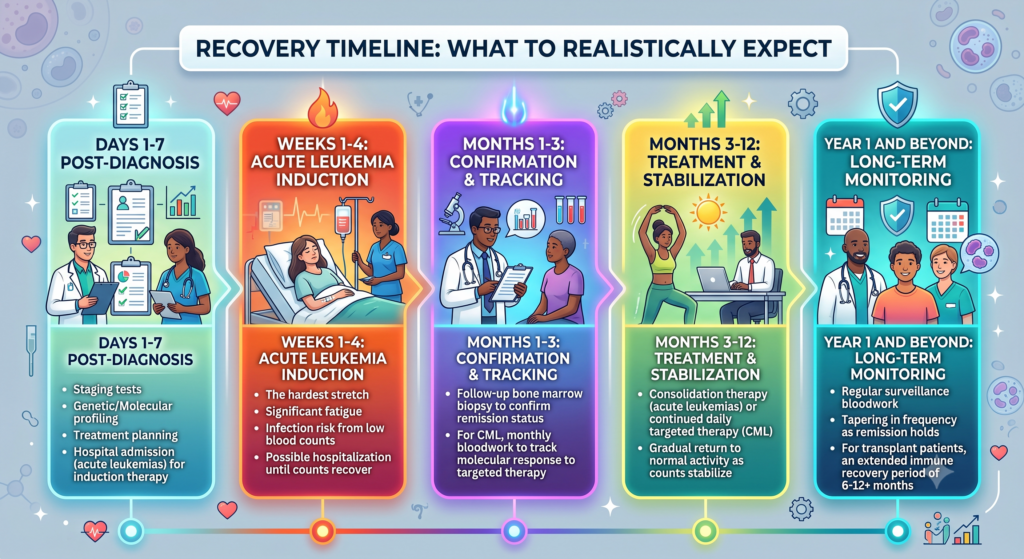
- Days 1–7 post-diagnosis: Staging tests, genetic/molecular profiling, treatment planning, and — for acute leukemias — hospital admission to begin induction therapy.
- Weeks 1–4 (acute leukemia induction): The hardest stretch. Expect significant fatigue, infection risk from low blood counts, and possible hospitalization until counts recover.
- Months 1–3: Follow-up bone marrow biopsy to confirm remission status; for CML, monthly bloodwork to track molecular response to targeted therapy.
- Months 3–12: Consolidation therapy (acute leukemias) or continued daily targeted therapy (CML); gradual return to normal activity as counts stabilize.
- Year 1 and beyond: Regular surveillance bloodwork, tapering in frequency as remission holds; for transplant patients, an extended immune recovery period of 6–12+ months.
Recovery timelines vary substantially by leukemia type and individual response — these ranges are general guidance, not a guarantee.
When to Seek Immediate Medical Attention
Don’t wait for a scheduled appointment if you experience:
- Bleeding that won’t stop, or blood in urine/stool
- A fever with chills that doesn’t resolve
- Sudden, severe shortness of breath
- Confusion, severe headache, or vision changes
- Signs of a serious infection (spreading redness, high fever, rapid heart rate)
These can signal a medical emergency requiring same-day evaluation, not a “wait two weeks and see.”
For further guidance, book an appointment with Dr. Kunal Behal,
Appointment : 070871 13922
OPD Schedule : Monday to Saturday (9:30 AM to 5:00 PM)
Frequently Asked Questions
References
- Cleveland Clinic. What Are Common Leukemia Symptoms? https://my.clevelandclinic.org/health/diseases/4365-leukemia
- City of Hope. Leukemia Symptoms and Signs. https://www.cityofhope.org/clinical-program/leukemia/symptoms
- Cancer Treatment Centers of America. What Are the Leukemia Symptoms and Signs? https://www.cancercenter.com/cancer-types/leukemia/symptoms
- Roswell Park Comprehensive Cancer Center. What Are the Symptoms of Leukemia in Women? https://www.roswellpark.org/cancertalk/202306/what-are-symptoms-leukemia-women
- Blood Cancer UK. Leukaemia Symptoms and Signs. https://bloodcancer.org.uk/understanding-blood-cancer/leukaemia/leukaemia-symptoms-signs/
- Rocky Mountain Cancer Centers. Early Symptoms of Leukemia. https://www.rockymountaincancercenters.com/blog/early-symptoms-of-leukemia
- Healthline. Acute Myeloid Leukemia (AML) Symptoms. https://www.healthline.com/health/leukemia/acute-myeloid-leukemia-symptoms
- American Society of Hematology. Leukemia. https://www.hematology.org/education/patients/blood-cancers/leukemia
- MedlinePlus, U.S. National Library of Medicine. Leukemia. https://medlineplus.gov/leukemia.html