Medically reviewed content written from the perspective of a practicing urologist. Educational use only; it does not replace care from your own obstetrician or urologist.
You open your lab report, see “Pus cells: 10–15/HPF,” and your stomach drops. Maybe your obstetrician has already said “we need to treat this.” Maybe you feel perfectly fine and are wondering what all the fuss is about. In my years of clinical practice, this is one of the most common reasons pregnant women are referred to me, and one of the most misunderstood.
Here is the short version. Pus cells in urine during pregnancy are a signal, not a diagnosis. Sometimes they point to a genuine urinary tract infection (UTI) that must be treated to protect you and your baby. Sometimes they are simply contamination from normal pregnancy discharge. Telling the difference is the whole game, and this guide shows you how.
What Is Pus Cells in Urine During Pregnancy?
“Pus cells” is the everyday term for white blood cells (leukocytes), mostly neutrophils, found in a urine sample. The medical term for their presence is pyuria.
- Typical reference range: up to about 5 white cells per high-power field (HPF) on microscopy of centrifuged urine. Many labs flag 0–5/HPF as normal and anything higher as raised.
- Where they come from: your immune system sends neutrophils to the urothelium (the lining of the bladder, ureters and renal pelvis) when it detects bacteria, inflammation or irritation.
- Why pregnancy changes the picture: progesterone relaxes the smooth muscle of the ureters, the growing uterus compresses the ureters (mostly on the right), and the glomerular filtration rate rises by roughly 50%. Urine flows more slowly (urinary stasis), sugar and amino acids leak into urine more readily, and bacteria multiply more easily. Hydronephrosis of pregnancy is physiological in most women.
Pyuria alone does not equal infection. It becomes meaningful when it is combined with symptoms, a positive urine culture, or a persistent pattern across repeat tests.
Clinical Note: How this really feels day to day Women rarely tell their doctor how much a “minor” urinary issue disrupts pregnancy. I hear about waking four to five times a night to pass small volumes, which wrecks sleep in an already uncomfortable third trimester. I hear about avoiding fluids to dodge the burning, which paradoxically worsens concentration of urine and irritation. Many women feel guilt (“Did I do something wrong?”) or anxiety every time a lab result arrives. Please hear this: UTIs in pregnancy are anatomical and hormonal, not a hygiene failure. Telling your care team about sleep loss, fluid avoidance and worry is part of good treatment.
Is Pus Cells in Urine Normal in Pregnancy?
A small number of white cells (within the lab’s reference range) is normal. A moderately raised count is common in pregnancy, but “common” is not the same as “harmless.”
There are three broad scenarios:
- Contamination only: vaginal discharge (physiological leukorrhea increases in pregnancy) washes into the sample. Epithelial cells are usually seen alongside pus cells, and the culture is negative or mixed.
- Asymptomatic bacteriuria (ASB): bacteria are growing in your urine, you feel nothing, and the pus cells may be modest or absent. This is present in roughly 2–10% of pregnancies and is the scenario most likely to be missed.
- True infection: cystitis (bladder) or pyelonephritis (kidney), usually with symptoms.
Common Causes of Pus Cells in Urine During Pregnancy
Urinary tract causes
- Asymptomatic bacteriuria: most often Escherichia coli, followed by Klebsiella pneumoniae, Proteus mirabilis, Enterococcus faecalis and Group B Streptococcus (GBS).
- Acute cystitis: infection of the bladder.
- Acute pyelonephritis: infection ascending to the renal pelvis and parenchyma; occurs in about 1–2% of pregnancies and is far more likely when ASB goes untreated.
- Urolithiasis (kidney or ureteric stones): can cause pyuria and haematuria with or without infection.
Non-urinary or sterile causes (“sterile pyuria”)
- Vaginal contamination or vulvovaginal candidiasis / bacterial vaginosis
- Chlamydia trachomatis or Neisseria gonorrhoeae (urethritis, cervicitis)
- Recent catheterisation or instrumentation
- Genitourinary tuberculosis (rare, but important in endemic regions)
- Interstitial cystitis / bladder pain syndrome
- Certain medications and dehydration
Risk factors that raise your odds
- Previous UTI or pyelonephritis
- Diabetes (including gestational diabetes)
- Sickle cell trait, urinary tract anomalies, or kidney disease
- Low socioeconomic circumstances and limited access to antenatal screening
- Multiparity (several previous pregnancies)
- Incomplete bladder emptying or a history of kidney stones.
Symptoms: When Pus Cells Come With a Story
Many women have no symptoms at all. When symptoms occur, they depend on where the infection sits.
Lower tract (cystitis):
- Burning or stinging when passing urine (dysuria)
- Urgency and frequency beyond usual pregnancy frequency
- Suprapubic discomfort
- Cloudy, strong-smelling urine, sometimes blood-tinged
Upper tract (pyelonephritis):
- Fever and chills or rigors
- Flank or loin pain (costovertebral angle tenderness)
- Nausea and vomiting
- Feeling generally very unwell
Why Pus Cells in Urine Are Often Misdiagnosed
This is where my experience matters most. I see errors in both directions.
Over-treatment:
- A contaminated, non-midstream sample shows 10–15 pus cells with plenty of squamous epithelial cells. The patient receives antibiotics she did not need.
- A dipstick leukocyte esterase result is treated as definitive, although dipsticks have false positives from vaginal secretions.
Under-treatment:
- A “normal” pus cell count is taken as reassurance, yet the culture would have grown >100,000 CFU/mL of E. coli (ASB can exist without pyuria).
- Symptoms are dismissed as “normal pregnancy frequency.”
- Sterile pyuria from chlamydia is labelled “UTI” and repeatedly treated with the wrong antibiotics.
The fix is simple: never rely on microscopy alone. A properly collected midstream clean-catch urine culture with antibiotic sensitivity testing is the gold standard.
Pus Cells in Urine During Pregnancy: Step-by-Step Guide
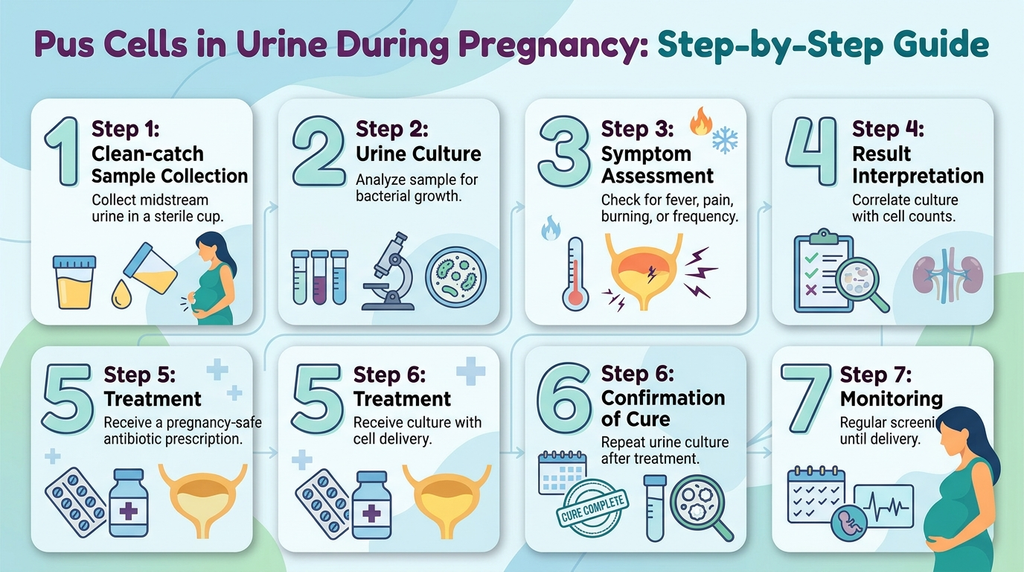
Here is the pathway I follow with pregnant patients.
- Collect the sample correctly. Wash hands, separate the labia, clean front to back with a sterile wipe or plain water, begin urinating into the toilet, then catch the midstream portion in a sterile container. Deliver it to the lab within an hour or refrigerate it.
- Get a urine culture and sensitivity, not just a routine urinalysis. Guidelines recommend screening for bacteriuria in early pregnancy (ideally at the first prenatal visit, 12–16 weeks) [1,2,4].
- Assess symptoms. Is there fever, flank pain, vomiting or contractions? If so, same-day assessment is needed.
- Interpret the result.
- Culture negative, epithelial cells present, no symptoms: probably contamination. Repeat a clean sample.
- Culture negative with pyuria: investigate sterile pyuria (vaginal swab, chlamydia/gonorrhoea NAAT, stones, TB if risk).
- Culture positive (typically ≥100,000 CFU/mL of a single uropathogen), with or without symptoms: treat.
- Treat with a pregnancy-safe, culture-directed antibiotic (see below).
- Confirm cure. Repeat the culture about 1–2 weeks after finishing treatment [4].
- Monitor. Women with a prior positive culture are screened periodically for the rest of pregnancy, and those with recurrence may need low-dose suppressive prophylaxis.
Treatment Options: What I Use and Why
Treatment is chosen based on the culture, gestational age, allergy history and local resistance patterns. Common pregnancy-compatible options:
| Antibiotic | Typical role | Key considerations |
| Cephalexin (first-generation cephalosporin) | Cystitis and ASB; very commonly my first choice | Well studied in pregnancy; avoid in severe penicillin/cephalosporin anaphylaxis |
| Amoxicillin-clavulanate | Culture-sensitive organisms | E. coli resistance to plain amoxicillin is now high, so use sensitivities |
| Nitrofurantoin | Uncomplicated lower UTI | Generally avoided in the first trimester if alternatives exist; avoid near term (risk of neonatal haemolysis) and in G6PD deficiency; not for pyelonephritis |
| Fosfomycin (single dose) | ASB/cystitis when adherence is a concern | Convenient; check local availability |
| Ceftriaxone (IV) | Pyelonephritis, often with admission | Standard inpatient option |
Antibiotics I avoid in pregnancy: fluoroquinolones (cartilage concerns), tetracyclines (fetal teeth and bone), and trimethoprim-sulfamethoxazole in the first trimester (folate antagonism) and at term (kernicterus concerns).
Course length is usually 5–7 days for ASB and cystitis, with 10–14 days total for pyelonephritis, following your obstetric team’s protocol.
Method A vs. Method B: Empiric vs. Culture-Directed Treatment
- Method A (empiric): start antibiotics immediately on symptoms and pyuria, then adjust. Faster relief, but a higher chance of unnecessary or mismatched antibiotics.
- Method B (culture-directed): wait 24–72 hours for sensitivities. More precise, but delays symptom relief.
My practice: I use empiric treatment (cephalexin or similar) when a woman is symptomatic or has fever, always after sending a culture first, then tailor therapy when results return. For a completely asymptomatic woman with mild pyuria, I prefer Method B: repeat a clean-catch culture and treat only if bacteria are confirmed. This avoids unnecessary exposure of the baby to antibiotics and reduces resistance. Women with prior pyelonephritis, diabetes or sickle cell trait get a lower threshold to treat.
Why we treat even without symptoms
Outside pregnancy, asymptomatic bacteriuria is generally left alone. In pregnancy, the evidence differs: untreated ASB is associated with a substantially higher risk of progressing to pyelonephritis, and with preterm birth and low birth weight. A Cochrane review found antibiotic treatment reduced pyelonephritis markedly, although the certainty of the evidence for preterm birth outcomes is low. Major guidelines still recommend screening and treating ASB in pregnancy .
A Real Patient’s Journey
Meera, 28, 22 weeks pregnant (second pregnancy). She came to me after two courses of antibiotics for “recurrent UTI.” Her lab reports repeatedly showed 8–12 pus cells/HPF. She felt mildly burning but mostly exhausted, waking several times at night.
What had gone wrong:
- Her samples were collected without midstream technique, and the lab noted abundant squamous epithelial cells.
- She had been given nitrofurantoin once and a different empiric antibiotic once, with no culture.
- Nobody had tested for vaginal infection.
What we did: a supervised clean-catch culture (negative for bacteria), a vaginal swab (positive for Candida and an imbalance consistent with bacterial vaginosis), and a chlamydia NAAT (negative). We treated the vaginal infection and counselled her on collection technique.
Outcome: her next two urine analyses showed 2–3 pus cells/HPF and no growth on culture. Her symptoms settled, she stopped avoiding fluids, and she delivered at term. Importantly, her story shows why a pus cell count alone is not enough.
Recovery Timeline: What to Expect
- 24–48 hours: burning and urgency start to improve on an effective antibiotic.
- 3–5 days: most cystitis symptoms are largely resolved; finish the full course regardless.
- 7 days: typical end of treatment for ASB or cystitis.
- 1–2 weeks after treatment: repeat urine culture to confirm cure.
- Rest of pregnancy: periodic repeat cultures (often monthly or per your obstetrician), especially if you have had a recurrence.
- Pyelonephritis: expect hospitalisation, IV antibiotics and fluids for 24–72 hours, then oral antibiotics to complete 10–14 days, sometimes followed by daily low-dose prophylaxis until delivery.
Best Practices to Lower Your Risk
- Drink enough water to keep urine pale yellow, unless advised otherwise
- Urinate regularly and fully; do not “hold it”
- Pass urine soon after sexual intercourse
- Wipe front to back and avoid douching or scented intimate products
- Wear breathable cotton underwear
- Keep blood glucose controlled if you have gestational or pre-existing diabetes
- Attend every antenatal screening visit, and complete your antibiotic course
- Evidence for cranberry products is mixed; discuss with your clinician rather than using it instead of antibiotics
When to Seek Immediate Medical Attention
Please do not wait for your next appointment if you experience:
- Fever of 38 °C (100.4 °F) or higher, or shivering and chills
- Severe flank or back pain
- Persistent vomiting or inability to keep fluids down
- Regular contractions, leaking fluid or vaginal bleeding
- Reduced fetal movements
- Visible blood in urine, confusion, rapid heartbeat or feeling faint (possible sepsis)
Pyelonephritis in pregnancy can lead to bacteraemia, septic shock and acute respiratory distress, which is why we treat it as an emergency.
Frequently Asked Questions
About the Author
Dr. Gaurav Sharma is a Consultant in Urology & Andrology at Amcare Hospital, VIP Road, Zirakpur, Punjab, serving patients across the Zirakpur and Chandigarh region. He holds an MBBS from Government Medical College, Aurangabad, a DNB in General Surgery (2008–2011) from Government General Hospital, Chandigarh, and a DNB in Urology from the Asian Institute of Nephrology and Urology (AINU), Hyderabad.
He has trained in laparoscopic urological surgery under Dr. C. Mallikarjuna, President of the Urological Society of India (USI), and has extensive experience in minimally invasive and uro-oncological surgery, including radical and partial nephrectomy. His clinical interests include kidney stones, urinary tract infection, prostate disease and male subfertility.
Areas of expertise: PCNL, URSL, RIRS (FURS), cystolithotripsy, nephrectomy, pyeloplasty, TURP (monopolar and bipolar), TURBT, endoscopic management of urethral stricture, urethroplasty, ureteric reconstruction (Boari flap), genitourinary trauma, and andrology (male infertility, sexual dysfunction, testicular torsion).
OPD: Monday to Saturday, 10:00 AM–1:30 PM and 6:00 PM–8:00 PM. Appointments: +91 70870 00200. View full profile
References
- American College of Obstetricians and Gynecologists. Urinary Tract Infections in Pregnant Individuals. Clinical Consensus No. 4. Obstet Gynecol. 2023;142(2):435–445.
- US Preventive Services Task Force. Screening for Asymptomatic Bacteriuria in Adults: Recommendation Statement. JAMA. 2019;322(12):1188–1194.
- Smaill FM, Vazquez JC. Antibiotics for asymptomatic bacteriuria in pregnancy. Cochrane Database of Systematic Reviews. 2019;(11):CD000490.
- Nicolle LE, Gupta K, Bradley SF, et al. Clinical Practice Guideline for the Management of Asymptomatic Bacteriuria: 2019 Update by the Infectious Diseases Society of America. Clin Infect Dis. 2019;68(10):e83–e110.
- Glaser AP, Schaeffer AJ. Urinary Tract Infection and Bacteriuria in Pregnancy. Urol Clin North Am. 2015;42(4):547–560.