Medically reviewed content written from clinical practice in orthopedic sports medicine.
If you’re in your teens, twenties, or thirties and your knee has been aching for weeks — or months — you’ve probably already heard “it’s just overuse, ice it and rest.” Sometimes that’s true. Often, it isn’t. Knee pain in young, otherwise healthy adults is one of the most common reasons people end up in my clinic, and it’s also one of the most frequently mismanaged complaints in general practice — not because the diagnosis is exotic, but because it hides in plain sight behind vague, overlapping symptoms.
This guide walks through what’s actually going on inside a young adult’s knee when it hurts, why the wrong diagnosis gets made so often, and what real, evidence-based treatment looks like.
Understanding the Condition: Why “Young Knee Pain” Is Its Own Category
The knee is the largest synovial joint in the body, and in people under 40 it behaves differently than it does in older adults. Most knee pain after age 55 is degenerative — osteoarthritis, cartilage thinning, meniscal wear from decades of use. Most knee pain in young adults is mechanical, biomechanical, or overuse-driven, layered onto a joint that is often still adapting to rapid growth, high training loads, or a sedentary-to-active lifestyle swing.
That distinction matters clinically. A 24-year-old with anterior knee pain almost never has osteoarthritis — but they might have patellofemoral pain syndrome, a tracking problem in the patella (kneecap), a ligament or meniscal injury, or a tendon overload issue. Treating a 24-year-old’s knee like a 65-year-old’s knee — or vice versa — is exactly how these cases get mismanaged.
Clinical Note:
What surprises most patients is how much knee pain affects things that have nothing to do with the knee itself. I regularly see young patients whose sleep is disrupted because they can’t find a comfortable position, whose gym routines collapse entirely (which affects mood and appetite regulation), and who develop real anxiety around stairs, driving (clutch/pedal work), or simply walking their dog. Chronic anterior knee pain has been linked in the literature to measurable increases in pain catastrophizing, fear-avoidance behavior, and anxiety, particularly in younger patients — this isn’t “in your head,” it’s a documented feedback loop between mechanical pain and psychological load.
The Real Causes of Knee Pain in Young Adults
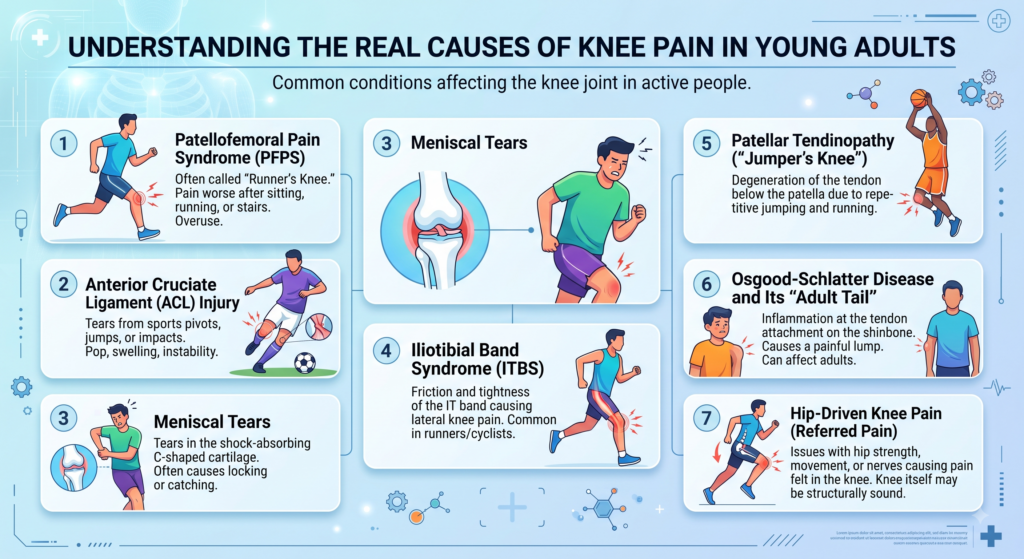
1. Patellofemoral Pain Syndrome (PFPS) — The Most Common Culprit
PFPS, sometimes called “runner’s knee,” is pain around or behind the kneecap caused by abnormal tracking of the patella within the femoral groove. It’s not a single injury — it’s a pattern of overload, often from a combination of weak hip stabilizers, quadriceps imbalance, and training errors.
- Annual prevalence in the general adult population runs around 22.7%, and in adolescents it’s even higher, at roughly 28.9%, making it one of the most common musculoskeletal complaints in this age group.
- It disproportionately affects women, likely due to a combination of pelvic width (Q-angle), hip and core strength deficits, and hormonal ligamentous laxity.
- Contributing factors include quadriceps tightness, poor hip abductor strength, flat feet or overpronation, and rapid increases in training volume.
Typical presentation: dull, aching pain behind or around the kneecap that worsens with stairs, squatting, prolonged sitting (“theater sign”), or running downhill.
2. Anterior Cruciate Ligament (ACL) Injury
The ACL is the primary stabilizer preventing the shin bone from sliding forward relative to the thigh bone, and it’s one of the most commonly injured ligaments in the body — especially in young, athletic populations.
- Roughly 100,000–200,000 ACL injuries occur annually in the United States, with an age- and sex-adjusted incidence of about 68.6 per 100,000 person-years.
- Risk peaks by sex and age: incidence is highest in males aged 19–25 (around 241 per 100,000 person-years) and in females aged 14–18 (around 227.6 per 100,000 person-years).
- Female athletes carry a 2–9 times higher relative risk of ACL injury than males in cutting/pivoting sports, attributed to differences in neuromuscular control, landing mechanics, and hormonal effects on ligament laxity.
- High school ACL injury rates rose to roughly 9.3 injuries per 100,000 athlete-exposures in the most recent tracked school year, continuing a multi-year upward trend.
Typical presentation: an audible “pop” at the time of injury, immediate swelling within hours, a feeling the knee is going to “give way,” and difficulty bearing weight.
3. Meniscal Tears
The menisci are C-shaped cartilage cushions that absorb shock between the femur and tibia. In young adults, tears are usually traumatic — a twisting injury during sport — rather than degenerative.
- An estimated 6–8% of young people in the U.S. sustain a meniscus injury in a given year, with incidence climbing as youth sports participation and training intensity increase.
- Roughly 80% of ACL reconstructions involve a concurrent meniscal tear or repair, which is why isolated ACL injury is relatively rare in high-velocity sports trauma.
Typical presentation: joint-line pain, mechanical catching or locking, and swelling that develops over 24–48 hours (slower than ACL swelling, which is often immediate).
4. Iliotibial Band Syndrome (ITBS)
ITBS is friction-related inflammation where the IT band — a thick fascial structure running down the outer thigh — rubs over the lateral femoral condyle during repetitive knee flexion/extension.
- It’s the most common cause of lateral knee pain in runners, with incidence estimated between 5% and 14% in that population, and accounts for roughly 12% of all running-related injuries.
- Military recruit studies have found rates over 20% during intensive training blocks.
- Weak hip abductors (especially gluteus medius), leg-length discrepancy, and sudden mileage increases are the classic contributing factors.
Typical presentation: sharp, burning lateral knee pain that starts after a predictable distance or time into a run and resolves with rest — until it doesn’t.
5. Patellar Tendinopathy (“Jumper’s Knee”)
Overload of the patellar tendon from repetitive jumping and landing — common in basketball, volleyball, and plyometric-heavy training — causes microtears and degenerative changes at the tendon’s attachment to the kneecap.
Typical presentation: localized pain at the inferior pole of the patella that’s worse at the start of activity, may ease as you warm up, then returns afterward.
6. Osgood-Schlatter Disease and Its “Adult Tail”
Classically a condition of adolescent growth spurts, Osgood-Schlatter involves inflammation at the tibial tuberosity where the patellar tendon attaches. Most cases resolve by skeletal maturity, but a meaningful subset of young adults carry a bony prominence and residual tendon sensitivity into their twenties, which can flare with heavy loading.
7.Hip-Driven Knee Pain (Referred Pain)
This is one of the most frequently missed causes. The knee is a common site for referred pain from hip pathology — femoroacetabular impingement (FAI), hip labral tears, or early hip dysplasia can all present as anterior or medial knee pain with a completely normal knee exam.
Risk Factors Across These Conditions
- Rapid increase in training volume or intensity (“too much, too soon”)
- Muscular imbalance — particularly weak hip abductors and quadriceps
- Poor movement mechanics under load (squatting, landing, cutting)
- Previous knee injury (a prior ACL tear raises contralateral tear risk roughly 6-fold)
- Anatomic factors: Q-angle, patellar height, femoral notch width, leg-length discrepancy
- Footwear and playing-surface changes
- Rapid growth during adolescence carrying into early adulthood
- Low bone density or nutritional deficits (particularly in athletes with disordered eating patterns)
Symptoms That Tell Different Stories
| Symptom pattern | Most likely source |
| Pain behind kneecap, worse on stairs/sitting | Patellofemoral pain syndrome |
| Pop + immediate swelling + instability | ACL tear |
| Joint-line pain + catching/locking + delayed swelling | Meniscal tear |
| Sharp outer knee pain during running, resolves at rest | ITBS |
| Pain at kneecap’s lower tip, worse with jumping | Patellar tendinopathy |
| Bony bump below kneecap, tender with kneeling | Osgood-Schlatter (residual) |
| Vague knee ache, normal knee imaging | Consider hip pathology |
Why Knee Pain in Young Adults Is So Often Misdiagnosed
I want to be direct about this, because it’s the single biggest source of patient frustration I see in clinic. Several of these conditions produce nearly identical anterior knee pain, which means a rushed five-minute visit often ends in the generic label “runner’s knee” — sometimes correctly, sometimes not.
The most common misdiagnosis patterns I encounter:
- ITBS mistaken for a meniscal tear (and vice versa). When standard conservative treatment for ITBS fails to improve symptoms, that failure itself is diagnostic information — it should prompt reconsideration of a lateral meniscal tear or popliteus tendinitis, not just “more of the same” treatment.
- PFPS treated with rest alone. PFPS is fundamentally a movement and strength problem, not simply an inflammation problem. Rest reduces pain temporarily but does nothing to correct the hip and quad weakness driving the poor patellar tracking — so it recurs.
- Hip pathology missed entirely because the exam stops at the knee. Any young adult with knee pain and a normal knee MRI deserves a hip exam.
- ACL tears initially dismissed as “just a sprain” when swelling is delayed or the patient can bear some weight — up to roughly a quarter of significant ligamentous knee injuries are initially under-recognized on first assessment.
From My Clinical Experience: A Real Patient’s Journey
A 26-year-old recreational runner came to me after eight months of lateral knee pain that had been treated twice as IT band syndrome — foam rolling, hip strengthening, a course of physical therapy, even a cortisone injection near the IT band insertion. Each round gave partial relief for a few weeks before the pain returned, always at almost exactly the same point in her runs.
What made me pause wasn’t the pain location — it was the pattern. True ITBS almost always improves meaningfully with a properly executed hip-strengthening program within 4–6 weeks. Hers hadn’t. On exam, she had tenderness slightly more posterior and inferior than classic ITBS, and a positive McMurray’s test suggesting meniscal involvement. An MRI confirmed a small lateral meniscal tear — likely present for most of those eight months, generating pain that mimicked ITBS closely enough to fool two rounds of otherwise appropriate treatment.
She underwent arthroscopic partial meniscectomy, followed by a structured 8-week rehabilitation program focused on quadriceps and hip strength. She was back to easy running at 10 weeks and full training volume at 16 weeks, with no recurrence at one-year follow-up.
The lesson I take from cases like this one, and share with every patient: if a “textbook” diagnosis isn’t responding to textbook treatment on a textbook timeline, that’s a signal to re-examine — not to repeat the same plan louder.
Treatment Options: What Actually Works, and Why I Choose One Approach Over Another
Conservative Management (First-Line for the Vast Majority of Cases)
For PFPS, ITBS, and patellar tendinopathy, conservative treatment is not a placeholder before “real” treatment — it is the real treatment, and it works when it’s actually targeted:
- Hip-focused strengthening (gluteus medius, external rotators) rather than knee-focused strengthening alone — because weak hip stabilizers are frequently the actual driver of poor patellar tracking, not the kneecap itself.
- Eccentric loading protocols for patellar tendinopathy, which have better evidence for tendon remodeling than rest or passive modalities alone.
- Gait and load management for runners — adjusting mileage progression, cadence, and footwear before assuming a structural problem.
- NSAIDs and activity modification for symptom control, used as a bridge to rehab, not a substitute for it.
When Surgery Enters the Conversation
ACL tears: This is where I spend the most time counseling patients, because the decision isn’t automatic. I compare two broad paths:
- ACL reconstruction (surgical) — generally my recommendation for young adults who want to return to cutting, pivoting, or jumping sports, because the native ACL has very limited capacity to heal on its own and residual instability significantly raises the risk of secondary meniscal and cartilage damage over time.
- Structured non-operative rehabilitation — I reserve this primarily for older, lower-demand patients, or those with straight-line-activity lifestyles (cycling, swimming) and no instability symptoms in daily life, because their functional demands don’t require the same rotational stability.
The variable that moves me most between these two paths isn’t age on paper — it’s functional demand and objective instability on exam. A 22-year-old who plays no pivoting sports and has a stable exam may reasonably choose rehab first; a 22-year-old competitive soccer player almost always needs reconstruction.
Graft choice matters too. For reconstruction, I generally compare:
- Bone-patellar tendon-bone autograft — stronger initial fixation, lower graft failure rate at 10 years (around 5% in some series), but higher rate of anterior knee pain and kneeling discomfort afterward.
- Hamstring tendon autograft — less anterior knee pain post-op, slightly higher graft laxity risk in very high-demand pivoting athletes.
I lean toward patellar tendon graft for competitive cutting-sport athletes under 25, and hamstring graft for patients whose sport or lifestyle makes kneeling comfort a higher priority — this is a genuine judgment call made with the patient, not a one-size answer.
Meniscal tears: Whenever the tear pattern and blood supply allow it, I favor repair over resection, particularly in young patients, because preserving meniscal tissue meaningfully reduces long-term osteoarthritis risk compared to removing it. Resection (partial meniscectomy) is reserved for tears in the avascular zone that have no realistic chance of healing.
Recovery Timelines: Be Honest About the Real Numbers
| Condition | Typical conservative recovery | Typical post-surgical recovery |
| PFPS | 6–12 weeks with consistent rehab | N/A (surgery rarely indicated) |
| ITBS | 4–8 weeks | N/A |
| Patellar tendinopathy | 8–16 weeks (tendon healing is slow) | N/A |
| Meniscal tear (repair) | — | 3–6 months to full sport |
| Meniscal tear (partial meniscectomy) | — | 6–10 weeks to full sport |
| ACL reconstruction | — | 9–12 months to full return to cutting/pivoting sport |
A note of transparency on ACL recovery: even with excellent rehabilitation, return-to-sport rates at pre-injury level hover around 90% at two years, but not everyone gets there symptom-free — long-term studies suggest roughly 50% develop some degree of osteoarthritis within 10–20 years of an ACL tear, regardless of whether it was treated surgically or not. This isn’t meant to discourage treatment; it’s meant to set honest expectations and underscore why prevention programs (neuromuscular training, landing mechanics coaching) matter as much as treatment.
When to Seek Immediate Medical Attention
Don’t wait for a routine appointment if you experience:
- A visible deformity or the knee looks “out of place”
- Inability to bear any weight on the leg
- Rapid, significant swelling within the first few hours of injury
- The knee locks and will not fully straighten or bend
- Signs of infection after any injection or surgery: fever, spreading redness, warmth, or pus at an incision
- Numbness, tingling, or a cold, pale foot below the injured knee (a possible vascular or nerve emergency)
Any of these warrants same-day evaluation, not a “wait and see” approach
This article is for educational purposes and does not replace an in-person evaluation. If you’re experiencing knee pain, particularly with swelling, instability, or locking, consult an orthopedic specialist or sports medicine physician for an individualized diagnosis.
For further guidance, book an appointment with Dr Mohak Kataria,
Appointment : 070871 13922
OPD Schedule : Monday to Saturday (9:30 AM to 5:00 PM)
Frequently Asked Questions
References
- Smith BE, Selfe J, Thacker D, et al. Incidence and prevalence of patellofemoral pain: A systematic review and meta-analysis. PLOS ONE. 2018;13(1):e0190892.
- PM&R KnowledgeNow. Patellofemoral Syndrome. American Academy of Physical Medicine and Rehabilitation.
- Sanders TL, Maradit Kremers H, Bryan AJ, et al. Incidence of Anterior Cruciate Ligament Tears and Reconstruction: A 21-Year Population-Based Study. Am J Sports Med. 2016.
- Beynnon BD, Vacek PM, Newell MK, et al. Why Female Athletes Injure Their ACLs More Frequently: What Can We Do to Mitigate Their Risk? Int J Sports Phys Ther.
- Aspen Institute / Project Play. Analysis: Serious Knee Injury Among Teen Athletes Grows 26%. 2023–2025 data update.
- Children’s Hospital of Philadelphia (CHOP) Sports Medicine. ACL Tear Risk Calculator and Pediatrics study summary, 1994–2013 trend data.
- van der Worp MP, van der Horst N, de Wijer A, Backx FJ, Nijhuis-van der Sanden MW. Iliotibial band syndrome in runners: a systematic review. Sports Medicine. 2012;42(11):969-992.
- Cleveland Clinic. Iliotibial Band Syndrome (ITBS): Causes, Symptoms & Treatment.
- StatPearls (NCBI Bookshelf). Iliotibial Band Syndrome. Updated 2023.
- Tian Y, Shen YL, Wang KL, et al. Advances in repair of non-discoid meniscus injuries in children: a narrative review. Frontiers in Pediatrics. 2026.
- Nguyen US, Zhang Y, Zhu Y, Niu J, Zhang B, Felson DT. Increasing prevalence of knee pain and symptomatic knee osteoarthritis: survey and cohort data. Ann Intern Med. 2011;155(11):725-32.