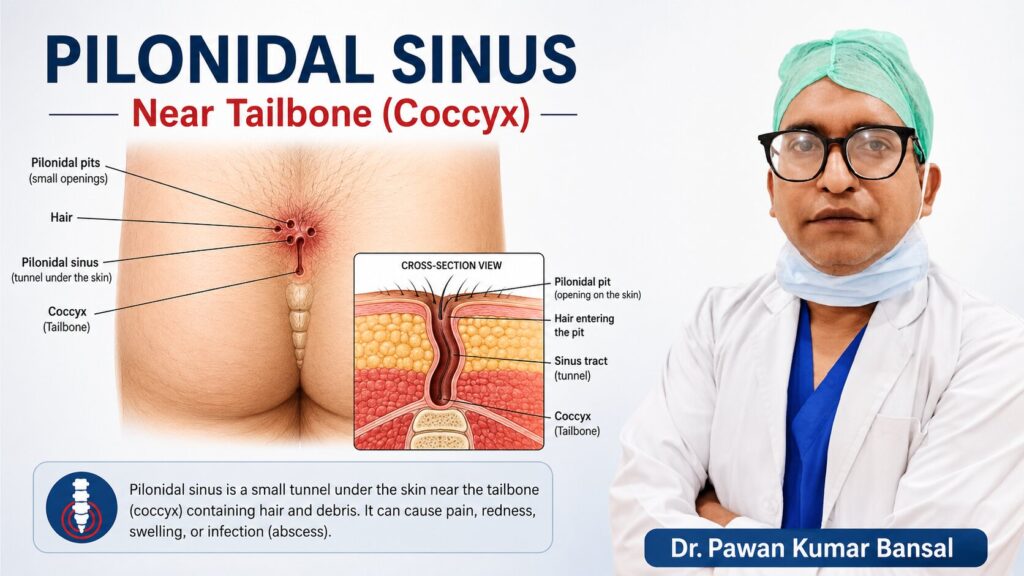
A pilonidal sinus is a small tunnel or tract that forms just under the skin at the top of the buttocks crease, near the tailbone.
It develops when loose hair, dead skin, and debris get pushed under the skin, usually from prolonged sitting or friction in that area.
The body treats this trapped material as foreign,and reacts to it which results in formation of a cyst or sinus tract under the skin. If it gets infected, it fills with pus and becomes a painful abscess.
In my OPD, this is one of the most under-recognised conditions I see. This is not because it is rare, but because it is routinely mistaken for something else.
Why Pilonidal Sinus Happens
The main risk factors include:
- Prolonged sitting – desk jobs, long commutes, driving professions.
- Excess body hair in the sacrococcygeal region.
- Obesity or a deep natal cleft.
- Poor local hygiene or excessive sweating.
- Family history of the condition.
- Skin trauma or irritation, such as from tight-fitting clothing or repetitive friction during physical activity.
Clinical Note: Repeated friction pushes the hair inward instead of letting it grow out. The trapped hair irritates the skin, so the body forms a wall around it. Over time this becomes a chronic sinus tract.
The Symptoms Patients Usually Describe
Most patients don’t come to me on day one. They come after weeks or months of symptoms they’ve been trying to manage on their own. Common symptoms observed:
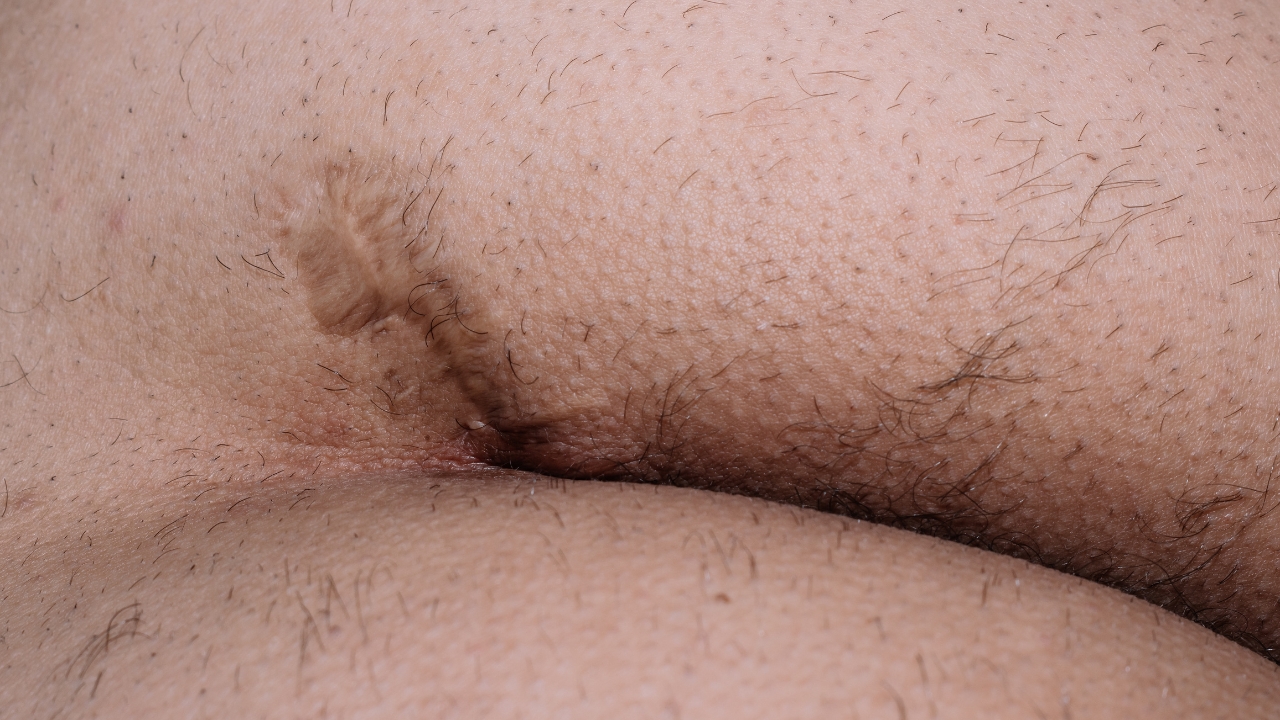
- A small dimple, swelling, or lump above the tailbone.
- Pain that worsens with sitting or walking.
- Pus or blood-stained discharge, often with an odour.
- Redness and warmth over the area if infected.
- Fever, in cases with an active abscess.
Clinical Experience: What patients often don’t connect to the condition is how much it affects daily life. Constant pain in that area changes how you sit and how you walk. It can even affect how much you eat, because sitting through a meal becomes uncomfortable.
Patients tell me their digestion felt “sluggish” simply because pain had disrupted their normal routine and appetite for weeks.
Why Pilonidal Sinus Is So Often Misdiagnosed
This is the part that frustrates me most as a surgeon. Pilonidal sinus sits in an area that gets casually written off as “a tailbone problem” or “a boil that will settle on its own.
“I regularly see patients who have already visited two, three, sometimes four different hospitals across Zirakpur, Panchkula, Chandigarh, and Ambala. At each one, they got a different diagnosis and a different treatment, but never a clear answer.”
The reason is simple: a pilonidal sinus can look like a common skin abscess in its early stage. Without a proper clinical examination of the natal cleft and a sinus opening check, it’s easy to misclassify.
As a result, patients go through repeated incision-and-drainage procedures, courses of antibiotics, or are simply told to ‘wait and watch.’ Meanwhile, the actual sinus tract stays untreated and keeps coming back.”
A correct diagnosis needs a focused clinical exam by looking specifically for the characteristic midline or off-midline pits above the tailbone and, where needed, imaging to map the extent of the tract before deciding on treatment.
How Pilonidal Sinus Is Actually Treated
Treatment depends entirely on the stage at which the patient presents.
- If there is an active abscess with pus formation The first priority is controlling infection never a surgery.
- I start with a course of targeted antibiotics to dry up the pus and bring down the acute inflammation. Operating on an actively infected area increases complication risk, so this step is non-negotiable when pus is present.
- Once the infection is controlled the sinus tract itself does not resolve with antibiotics alone.Once the acute infection settles, the tract needs to be surgically excised, otherwise the recurrence rate is high.
- For simple, uncomplicated cases, a minor procedure like laying open the sinus or removing a small amount of tissue may be enough. But for chronic, recurrent, or more extensive disease, a flap procedure gives the best long-term result. This is the technique I use in these cases.
About Flap Surgery
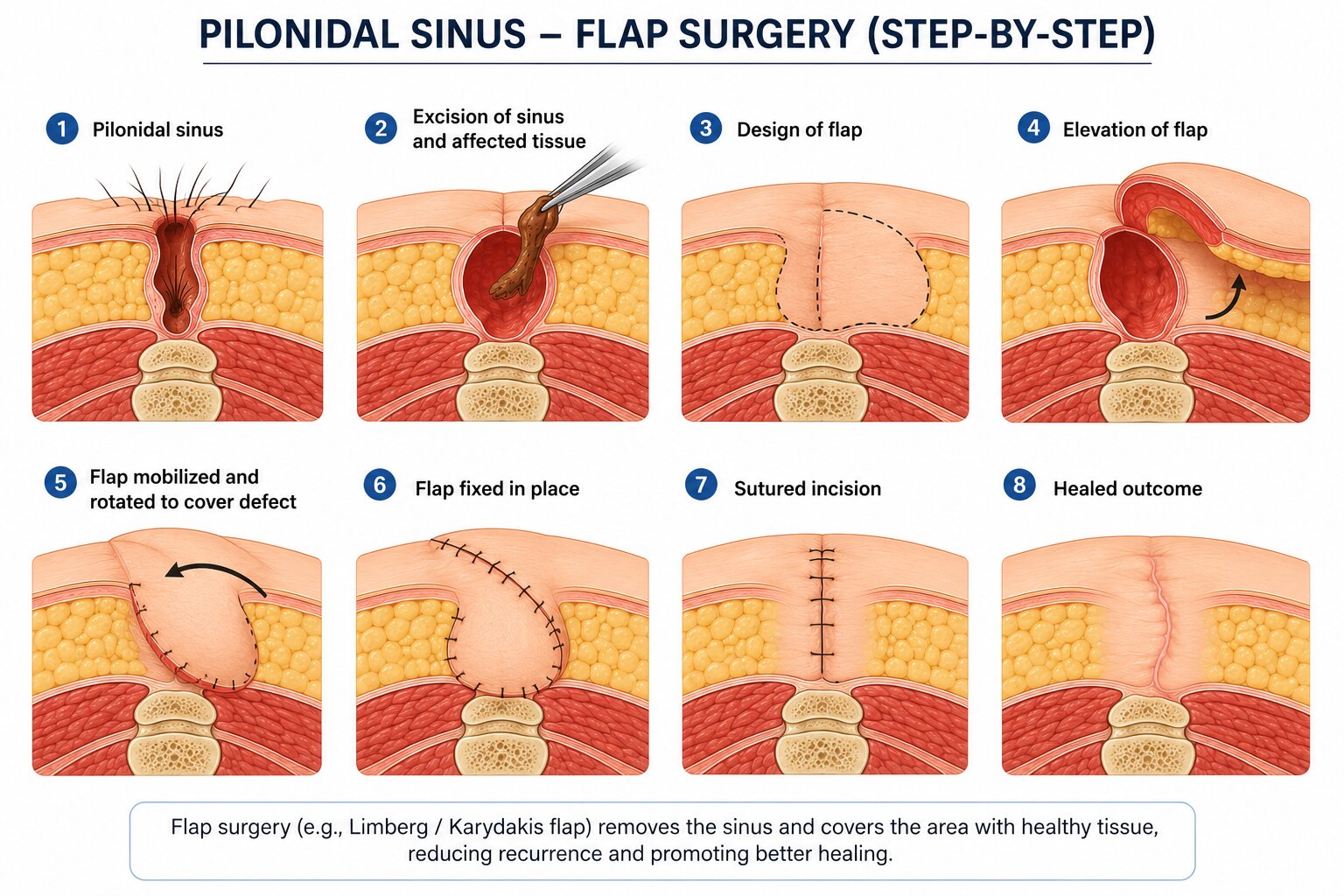
Flap surgery works by excising the entire sinus tract along with the affected tissue, then reconstructing the area with a flap of adjacent healthy tissue, closing the wound off the midline.
Off-midline closure matters clinically as it works best because it moves the scar out of the deep, moist crease where recurrence risk is highest, that is why midline closure has fallen out of favour (decreasing utilization of procedure) in current surgical practice.
The two most established flap techniques are the Karydakis flap and the Limberg flap. Studies comparing the two show similar recurrence rates, usually between 2% and 7%.
The Karydakis flap tends to allow a faster return to normal activity and gives better cosmetic results in some studies. The Limberg flap tends to have fewer complications in others. Both are proven, reliable options, and the right choice depends on your specific case.
I choose between the two procedures based on the shape and size of the patient’s tract. There is no single treatment option for everyone. Each case is different, so the technique is chosen to fit the patient.
A Real Patient’s Journey Through This Condition
I want to walk you through a recent case in my own practice, because it illustrates almost everything discussed above.
The patient had been struggling with the condition for a considerable period before she came to Amcare. She had visited multiple hospitals across the Tricity – Chandigarh, Ambala, Panchkula, and Zirakpur and at each one patient received a different opinion.
Some told her it was a tailbone problem. Others suggested different treatments altogether. None of them arrived at the correct diagnosis.
By the time I examined her, she had significant difficulty walking and sitting, and had been managing constant pain that had disrupted her normal routine, including her appetite and digestion. On examination, the findings were consistent with a pilonidal sinus with active pus formation.
Me & My team followed the exact protocol described above: first, a course of antibiotics to dry the infection and settle the acute inflammation. Once that was controlled, we proceeded with flap surgery to excise the tract completely and close the wound off the midline.
Her recovery was complete within three weeks, after which she returned to normal walking, sitting, and daily activity without the pain that had defined months of her life before treatment.
She shares her own experience in the video – from the frustration of repeated misdiagnosis to what recovery actually felt like after surgery. I’d encourage anyone currently in her position, unsure of what’s happening to their body, to watch it.
Recovery Timeline After Flap Surgery
Most patients ask me the same question before surgery: “How long before I’m back to normal?” Here’s what a typical recovery looks like:
- Week 1: Rest, wound care, and pain management; avoiding direct pressure on the surgical site.
- Week 2: Gradual return to light movement and walking; dressing changes continue.
- Week 3: Most patients, like the case above, are largely back to normal sitting and walking tolerance.
- Beyond 3 weeks: Full return to work and routine activity, with continued attention to hygiene and hair removal around the area to reduce recurrence risk.
After Care Tips: Surgery is only half the job. The other half is what you do afterward. I tell every patient the same few things: keep the area clean and dry, take care of hair growth around it, don’t sit for hours at a stretch without getting up, and try to stay at a healthy weight. None of this is complicated, but it makes a real difference in whether the sinus stays gone.”
When You Should See a Surgeon, Not Wait It Out
If you notice a persistent dimple, swelling, or discharge above the tailbone that doesn’t resolve in a week or two weeks, or if you’ve already been given different diagnoses at different clinics, that’s the right time to seek a focused surgical opinion rather than another round of antibiotics for a presumed boil.
Chronic, untreated pilonidal disease doesn’t resolve on its own, and delaying correct treatment usually means a longer, more complicated recovery later.
Getting the Right Diagnosis Matters More Than the Treatment Itself
If you take away just one thing from this article, let it be this: with pilonidal sinus, the surgery is rarely the hard part. Getting the right diagnosis is. Most of the suffering I see in my OPD isn’t from the condition itself, it’s from months spent being treated for something else entirely.”
If you’re dealing with unexplained pain, swelling, or discharge near your tailbone and haven’t received a clear answer yet, I’d recommend getting it examined properly.
You can book a consultation with our General Surgery department at Amcare Hospital, Zirakpur, for an accurate diagnosis and a treatment plan suited to your specific case.
Book Consultation:
Call us on : +91 9988770850
Click : Book An Appointment with Consultant
About Author : Dr. Pawan Kumar Bansal Consultant, general & laproscopic surgeon
Frequently Asked Questions
A pilonidal sinus is a small tunnel that forms under the skin at the top of the buttocks crease, near the tailbone, caused by trapped hair, dead skin, and debris. If infected, it fills with pus and becomes a painful abscess.
It’s caused by repeated friction that pushes hair inward instead of letting it grow out. Risk factors include prolonged sitting, excess body hair, obesity, poor hygiene, excessive sweating, family history, and age between 15-30.
Common symptoms include a small dimple or lump above the tailbone, pain that worsens with sitting or walking, pus or blood-stained discharge with odour, redness and warmth if infected, and fever with an active abscess.
Flap surgery excises the entire sinus tract along with affected tissue, then reconstructs the area using a flap of healthy adjacent tissue, closing the wound off the midline to lower recurrence risk. It’s used for chronic, recurrent, or extensive disease.
If there’s an active abscess, antibiotics are used first to control infection. Once settled, the sinus tract is surgically excised; for simple cases, minor procedures suffice, while chronic or extensive disease requires a flap procedure.
Recovery typically takes about 3 weeks. Week 1 involves rest and wound care, week 2 brings gradual movement, and by week 3 most patients return to normal sitting and walking, with full routine activity resuming shortly after.