If your last blood draw came back with a low hemoglobin number, you’re not alone — and you’re not doing anything wrong. Roughly a third to 40% of pregnant women worldwide develop anemia at some point in pregnancy, most often from iron deficiency. As a practicing obstetrician, I see this on nearly every prenatal panel I review, and I understand the wave of worry that comes with a flagged lab value. The good news: in the overwhelming majority of cases, this is one of the most correctable conditions in all of prenatal care — if you know exactly what’s driving it and how to treat it for your trimester, your severity, and your gut’s tolerance.
This guide walks through the physiology, the red flags, and the specific, evidence-based options — diet, oral iron, IV iron, and beyond — that I discuss with patients in clinic.
Understanding the Condition: What “Low Hemoglobin” Actually Means in Pregnancy
Hemoglobin is the oxygen-carrying protein inside your red blood cells (erythrocytes). During pregnancy, your blood plasma volume expands by 40–50% to support the growing fetoplacental unit, while your red cell mass increases by a smaller margin. This creates a normal, expected dilution effect — which is exactly why the diagnostic cutoffs for anemia change depending on how far along you are.
Under the framework used by the American College of Obstetricians and Gynecologists (ACOG) and the CDC, anemia in pregnancy is defined as:
- First or third trimester: hemoglobin under 11 g/dL (hematocrit under 33%)
- Second trimester: hemoglobin under 10.5 g/dL (hematocrit under 32%), reflecting the physiologic nadir caused by peak plasma expansion
Notably, these thresholds are now applied universally to all patients — earlier race-based diagnostic criteria have been retired specifically to avoid under-diagnosing and under-treating anemia in Black patients, who were previously held to different (and inequitable) cutoffs.
Severity is generally staged as:
- Mild: 10.0–10.9 g/dL
- Moderate: 7.0–9.9 g/dL
- Severe: below 7.0 g/dL
Clinical Note
In my practice, I’ve noticed that the symptom burden of anemia rarely maps cleanly onto the hemoglobin number on paper. A patient with a hemoglobin of 10.3 g/dL who has been iron-deficient for months may feel far worse — more fatigued, more short of breath climbing stairs, more prone to a racing heart, more likely to have disrupted sleep from restless legs — than someone whose hemoglobin dropped suddenly to a similar number. Chronic iron deficiency also has a well-documented effect on mood and cognition; patients frequently describe a “brain fog” and low motivation that they assume is just pregnancy exhaustion, when it’s actually a treatable iron problem. I always ask about appetite, concentration, hair shedding, and cravings for ice or starch (a classic sign called pica) — these are things a hemoglobin number alone won’t tell you.
Why It Happens: Causes of Low Hemoglobin in Pregnancy
Anemia in pregnancy is not one condition — it’s a final common pathway with several distinct drivers. Iron deficiency accounts for roughly half of all cases in women of reproductive age, but it is far from the only cause.
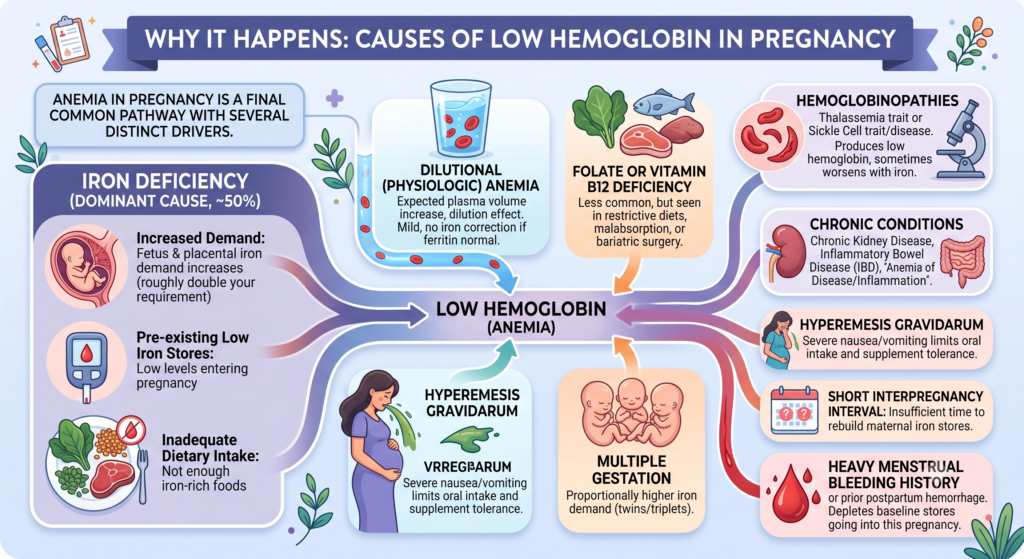
Common causes include:
- Iron deficiency — the dominant cause, driven by increased fetal and placental iron demand (pregnancy roughly doubles your iron requirement), pre-existing low iron stores, and inadequate dietary intake
- Dilutional (physiologic) anemia — the expected plasma-volume effect described above; usually mild and doesn’t need iron correction if ferritin is normal
- Folate or vitamin B12 deficiency — less common in fortified-food countries, but seen in patients with restrictive diets, malabsorption, or prior bariatric surgery
- Hemoglobinopathies — thalassemia trait or sickle cell trait/disease, which can produce a low hemoglobin that does not respond to iron and sometimes worsens with it
- Chronic conditions — chronic kidney disease, inflammatory bowel disease, or other causes of “anemia of chronic disease/inflammation”
- Hyperemesis gravidarum — severe nausea/vomiting limiting oral intake and supplement tolerance
- Multiple gestation (twins/triplets) — proportionally higher iron demand
- Short interpregnancy interval — insufficient time to rebuild maternal iron stores between pregnancies
- Heavy menstrual bleeding history or postpartum hemorrhage in a prior pregnancy — depletes baseline iron stores going into this pregnancy
Symptoms: What to Watch For
Many patients with mild anemia have no symptoms at all — this is exactly why routine screening (a complete blood count at your first prenatal visit and again around 28 weeks) matters more than how you feel day to day.
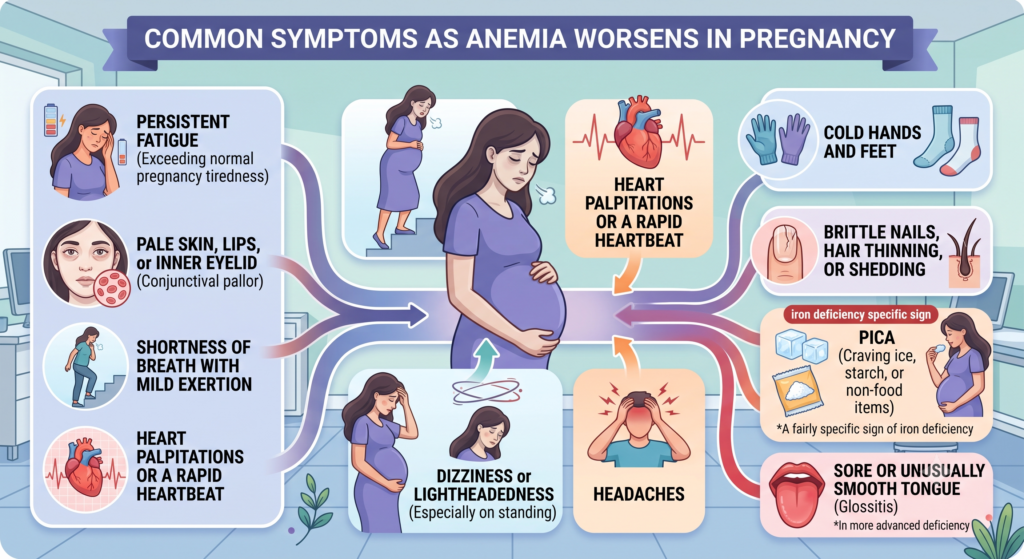
Common symptoms as anemia worsens:
- Persistent fatigue disproportionate to normal pregnancy tiredness
- Pale skin, lips, or inner eyelid (conjunctival pallor)
- Shortness of breath with mild exertion
- Heart palpitations or a rapid heartbeat
- Dizziness or lightheadedness, especially on standing
- Headaches
- Cold hands and feet
- Brittle nails, hair thinning or shedding
- Restless legs, particularly at night
- Pica (craving ice, starch, or non-food items) — a fairly specific sign of iron deficiency
- Sore or unusually smooth tongue (glossitis) in more advanced deficiency
Why Anemia Is Frequently Missed or Misattributed
This is a topic I care about deeply, because under-recognition has real consequences. In practice, anemia symptoms get misattributed to “normal pregnancy” more often than almost any other correctable condition I encounter. A few reasons why:
- Symptom overlap. Fatigue, breathlessness, and dizziness are so common in pregnancy generally that a genuinely anemic patient can be reassured that “this is just pregnancy” without anyone rechecking the labs.
- Single-timepoint screening. A hemoglobin that’s normal at 10 weeks doesn’t guarantee it stays normal at 28 weeks — iron demand rises sharply in the second half of pregnancy. Patients (and sometimes providers) assume one normal early result means they’re covered for the rest of pregnancy.
- Ferritin isn’t always checked. Hemoglobin can still be in a “borderline normal” range while iron stores (ferritin) are already critically low — this is the early, easily treatable stage of iron deficiency, and it’s frequently skipped in routine screening unless specifically ordered.
- Prenatal vitamin ≠ treatment dose. Many patients assume that because they’re taking a prenatal vitamin with iron, they’re automatically protected. Most prenatal formulations contain 15–30 mg of elemental iron — appropriate for prevention, but well below the 30–120 mg/day typically needed to correct an existing deficiency.
Treatment Options: Comparing Your Choices
The right treatment depends on your trimester, your hemoglobin level, your ferritin, your symptoms, and — critically — how well you tolerate oral iron. Here is how I walk patients through the options.
1.Dietary Iron Optimization
For borderline-low or mild cases, or as a foundation alongside supplementation, diet matters.
Heme iron (better absorbed, ~15–35% bioavailability):
- Lean red meat, poultry, liver
- Fish and shellfish (choose low-mercury options)
Non-heme iron (~2–20% bioavailability, absorption boosted by vitamin C):
- Lentils, beans, chickpeas
- Tofu and edamame
- Spinach and other dark leafy greens
- Fortified cereals
- Pumpkin seeds, cashews
Absorption tips:
- Pair non-heme iron sources with vitamin C (citrus, bell pepper, strawberries) to significantly increase absorption
- Avoid taking iron-rich meals with coffee, tea, or calcium supplements, which inhibit absorption — space these by 1–2 hours
Diet alone is rarely sufficient to correct an established iron-deficiency anemia in pregnancy, given the magnitude of iron needed, but it meaningfully supports whichever supplement strategy you’re on.
2. Oral Iron Supplementation — First-Line for Most Patients
For confirmed iron-deficiency anemia, oral ferrous iron salts (ferrous sulfate, ferrous fumarate, ferrous gluconate) remain first-line therapy in most guidelines, typically dosed to provide 60–120 mg of elemental iron per day for the correction phase.
A key nuance most patients haven’t heard: dosing frequency matters. Research on iron absorption physiology has shown that a single oral dose of iron triggers a rise in hepcidin — the hormone that regulates iron absorption — which can blunt absorption from a second dose taken later the same day, for up to about 24–48 hours. This has led several trials to test alternate-day dosing (taking your iron supplement every other day rather than daily) as a strategy to improve absorption per dose and reduce GI side effects, with encouraging — though still evolving — results. If you’ve struggled with nausea or constipation on daily iron, this is worth discussing with your provider.
Practical tips for tolerance:
- Take iron on an empty stomach when possible for maximal absorption, but with a small snack if nausea is limiting
- Pair with vitamin C (a splash of orange juice) to boost absorption
- Avoid taking simultaneously with calcium, antacids, or your prenatal multivitamin’s calcium content — these compete for absorption
- If constipation is significant, a stool softener alongside iron is often more sustainable than stopping the supplement
- Give it 2–4 weeks before judging effectiveness — recheck hemoglobin around that interval
3. Intravenous (IV) Iron — When Oral Isn’t Enough or Fast Enough
IV iron has moved from a “last resort” to a genuinely first-line consideration in specific situations, and the evidence base for this has grown substantially. A 2025 systematic review and meta-analysis pooling several randomized trials found that IV iron produced a significantly greater rise in maternal hemoglobin than oral iron (mean difference of roughly +1.2 g/dL) and nearly doubled the odds of fully correcting anemia, with fewer gastrointestinal side effects overall. The landmark FER-ASAP trial similarly found that a higher proportion of women reached a normal hemoglobin on IV ferric carboxymaltose than on oral ferrous sulfate, and did so faster (median about 3.4 weeks versus 4.3 weeks).
I typically recommend IV iron when:
- Hemoglobin is moderately-to-severely low (roughly below 9–10 g/dL) with confirmed iron deficiency, especially later in pregnancy where there isn’t time for oral therapy to work
- The patient has failed or truly cannot tolerate oral iron due to GI side effects
- There’s malabsorption (inflammatory bowel disease, prior bariatric surgery, celiac disease)
- Anemia is discovered close to the anticipated delivery date, where rapid correction reduces the risk of needing a blood transfusion around delivery
Why I often prefer ferric carboxymaltose or ferric derisomaltose over older IV formulations when IV therapy is indicated: these newer formulations allow a large replacement dose in a single infusion (versus multiple visits with older iron sucrose regimens), have a well-established safety profile in pregnancy from the second trimester onward, and carry a low risk of the hypersensitivity reactions that made earlier IV iron formulations (like high-molecular-weight iron dextran) less favored. That said, IV iron is generally avoided in the first trimester out of caution, given more limited safety data in that specific window.
4. Vitamin and Micronutrient Co-Treatment
- Folate and B12 should be checked if the anemia doesn’t respond as expected to iron, or if red blood cells appear larger than normal (macrocytic) on the complete blood count — this pattern suggests a different driver than iron deficiency
- Vitamin C as an absorption adjunct, as above
- Avoid excessive, unsupervised high-dose supplementation of multiple micronutrients simultaneously, since some (like zinc and calcium) can interfere with iron absorption
5. Blood Transfusion — Reserved for Severe or Symptomatic Cases
Transfusion is generally reserved for hemoglobin below roughly 7 g/dL, or higher levels accompanied by significant symptoms, cardiovascular compromise, or an urgent need to correct anemia before an imminent delivery or in the setting of active bleeding. It is not a routine treatment for iron-deficiency anemia and carries its own risks, so it’s used selectively.
From My Clinical Experience: A Patient’s Journey
The following is a composite, anonymized case reflecting a pattern I see regularly in practice — not an individual patient’s real record.
Aarti, a 29-year-old in her second pregnancy, came in at 26 weeks reporting fatigue she described as “bone-deep” — different from the tiredness she remembered from her first pregnancy. She was also having trouble concentrating at work and had started chewing on ice constantly, which she’d dismissed as “a weird pregnancy thing.”
Her hemoglobin at her first visit, back at 9 weeks, had been 12.1 g/dL — normal — so it hadn’t been rechecked since. When we finally repeated labs at 26 weeks, her hemoglobin had dropped to 9.4 g/dL, and her ferritin came back at 6 ng/mL, confirming significant iron deficiency. In her first pregnancy, a short interpregnancy interval of about 14 months meant she likely never fully rebuilt her iron stores before this pregnancy began.
We started oral ferrous sulfate at a correction dose. Two weeks in, she called the office nauseated and unable to keep the pills down consistently — a common story. Rather than pushing through with a supplement she couldn’t tolerate (which usually just leads to quiet non-adherence), we switched her to a single infusion of IV ferric carboxymaltose. Her energy noticeably improved within about two weeks, the ice cravings resolved, and her hemoglobin at her 32-week recheck had risen to 11.2 g/dL. She delivered at term without needing a blood transfusion — a real and meaningful risk reduction, since anemia entering labor is one of the strongest predictors of needing a transfusion for postpartum hemorrhage.
What this case illustrates, and what I emphasize to every patient: a single normal early hemoglobin doesn’t protect you for the rest of pregnancy, ferritin catches deficiency before hemoglobin does, and there’s no reason to suffer through an intolerable oral regimen when effective alternatives exist.
Recovery Timeline: What to Expect
- Week 1–2 on oral iron: Some patients notice modest energy improvement; hemoglobin itself hasn’t moved much yet — red blood cell production takes time
- Week 3–4: Hemoglobin typically begins a measurable rise (often around 1 g/dL over 3–4 weeks with adequate oral therapy); this is the standard interval for a recheck
- After IV iron: Meaningful hemoglobin rise is often seen within 1–3 weeks, faster than oral therapy in most trials
- 6–8 weeks: Ferritin (iron stores) starts to normalize, though this lags behind hemoglobin correction
- Postpartum: Iron needs remain elevated after delivery due to blood loss at birth; continuing supplementation for at least 6–8 weeks postpartum, or longer if breastfeeding and still deficient, is common practice
When to Seek Immediate Medical Attention
Most anemia in pregnancy is manageable on an outpatient basis, but don’t wait for your next scheduled visit if you experience:
- Chest pain, palpitations that don’t resolve with rest, or shortness of breath at rest
- Fainting or near-fainting episodes
- Heavy vaginal bleeding of any kind
- Severe, worsening fatigue that prevents you from functioning
- Signs of an allergic reaction after starting a new iron supplement or during/after an IV iron infusion (hives, facial swelling, difficulty breathing) — seek emergency care immediately
- Any new symptom that feels different or more severe than your usual pregnancy fatigue
These can signal either severe anemia decompensating or a separate urgent problem, and both deserve prompt evaluation rather than a “wait and see” approach.
Frequently Asked Questions
This article is for educational purposes and does not replace individualized medical advice. Please discuss your specific hemoglobin levels, ferritin, and treatment plan with your obstetric provider.
For further guidance, book an appointment with Dr Yukta Sharma.
Appointment : 070870 00200
OPD Schedule : Monday to Saturday (9:30 AM to 5:00 PM)
References
- American College of Obstetricians and Gynecologists (ACOG) and Centers for Disease Control and Prevention (CDC) diagnostic criteria for anemia in pregnancy, as summarized in: Auerbach M, et al. “Identifying and treating iron deficiency anemia in pregnancy.” Hematology Am Soc Hematol Educ Program. 2023.
- Ubom AE, et al. “FIGO good practice recommendations on anemia in pregnancy, to reduce the incidence and impact of postpartum hemorrhage.” International Journal of Gynecology & Obstetrics. 2025.
- World Health Organization. Trimester-based hemoglobin thresholds for diagnosis of maternal anemia (2024 reclassification), as referenced in FIGO 2025 guidance.
- Govindappagari S, Burwick RM. “Treatment of Iron Deficiency Anemia in Pregnancy with Intravenous versus Oral Iron: Systematic Review and Meta-Analysis.” American Journal of Perinatology. 2019;36(4):366-376.
- Breymann C, Milman N, et al. “Ferric carboxymaltose vs. oral iron in the treatment of pregnant women with iron deficiency anemia: an international, open-label, randomized controlled trial (FER-ASAP).” Journal of Perinatal Medicine. 2017;45(4):443-453.
- Systematic review and meta-analysis: “Efficacy and Safety of Intravenous Versus Oral Iron in Treating Maternal Anaemia During Pregnancy.” PMC. 2025.
- Stoffel NU, Zeder C, Brittenham GM, Moretti D, Zimmermann MB. “Iron absorption from supplements is greater with alternate day than with consecutive day dosing in iron-deficient anemic women.” Haematologica. 2020;105(5):1232-1239.
- Moretti D, Goede JS, Zeder C, et al. “Oral iron supplements increase hepcidin and decrease iron absorption from daily or twice-daily doses in iron-depleted young women.” Blood. 2015;126(17):1981-1989.
- “Iron mother — protocol for a randomised controlled trial of daily versus alternate day ferrous fumarate for the treatment of iron deficiency anaemia in pregnancy.” ScienceDirect / Contemporary Clinical Trials Communications. 2025.