

Medically reviewed by: [Dr Kunal Behal, Internal Medicine]
Editor’s note (delete before publishing):
- Navel displacement is not a recognized medical diagnosis. It appears in folk, Ayurvedic and Unani traditions but is not in the ICD, and no medical research on it could be traced. This article therefore treats it honestly, as a traditional belief that often masks real conditions.
If someone told you your “nabhi has slipped” or “dhoran has shifted,” you are not alone. In many families, an elder diagnoses it by feeling for a pulse near the belly button, and a local healer then “re-centres” it. If you are in pain, that explanation can be comforting. But in my clinical practice, I have learned that the belly pain is real, and the “displaced navel” is usually not the cause.
This guide explains what the belief is, what is likely going on in your body, which treatments work, and which symptoms mean you should see a doctor today.
Understanding the Condition: What Is “Navel Displacement”?
Navel displacement (also called nabhi khisakna, nabhi sarakna or dharan) is a traditional belief that the body’s “navel centre” shifts out of place, often after lifting heavy objects, jerking movements or a fall. It is described as being similar to a spinal misalignment.
It is important to be clear about its status:
- In Ayurveda and Unani the navel is considered important for health, but Western (allopathic) medicine has no corresponding concept.
- An official from the Central Council for Research in Homoeopathy (Ministry of AYUSH) has stated it is not a recognized term in the International Classification of Diseases.
- There is no anatomical structure called a “navel centre” that can slip. The umbilicus is the scar of the umbilical cord, fixed to the linea alba, the fibrous midline seam between the rectus abdominis muscles.
Symptoms People Attribute to a Displaced Navel
Popular health pages link it to pain, diarrhoea, vomiting, constipation and nausea . In practice, patients describe:
- Dull or cramping pain around or below the navel (periumbilical pain)
- Bloating, gas and loose stools or constipation
- Nausea or reduced appetite
- Low back discomfort
- In women, menstrual discomfort
Why It Gets Misdiagnosed: The “Pulse Test” Problem
The usual home test is to lie flat and feel for a pulse beside the navel. If it is not felt in the “right” spot, the navel is declared displaced.
Here is the clinical reality. What a person feels there is usually the abdominal aorta transmitting its pulse. Whether you can feel it depends on body build, abdominal wall thickness, muscle tension and where the examiner presses. It is not a validated diagnostic test. (Conversely, a strong, expanding pulsation in an older adult, especially a smoker with hypertension, deserves a medical check for an aortic aneurysm.)
Clinical Note: how this affects daily life Unexplained belly pain is exhausting in a way people underestimate. Patients tell me they skip meals out of fear of triggering it, sleep badly, and carry constant low-grade anxiety. Parents feel guilty about a child’s recurring stomach aches. When a family is told “the navel has moved” and the pain returns a week later, trust in the whole health system can erode. Abdominal pain and anxiety also feed each other through the gut-brain axis, so reassurance and a clear plan are themselves part of treatment.
What Is Really Going On: Common Causes of Pain Around the Navel
- Functional abdominal pain and irritable bowel syndrome (IBS). Unexplained stomach ache, mostly in younger children, is often labelled “navel displacement” by non-medical people. Recurrent pain with no structural cause is very common.
- Constipation and trapped gas.
- Gastroenteritis (infective diarrhoea and vomiting).
- Umbilical or paraumbilical hernia, a bulge at the navel, sometimes tender.
- Abdominal wall pain, including muscle strain from lifting, which may be the genuine kernel of truth behind “pain after lifting a heavy object.”
- Early appendicitis, which often begins as vague pain around the navel before moving to the lower right abdomen. This is the most important reason not to dismiss the pain.
- Mesenteric lymphadenitis in children, urinary tract infection, gynaecological causes, and less commonly pancreatitis or bowel obstruction.
How Does Navel Displacement Treatment Work?
Traditional treatment is manual. Practitioners:
- Reposition the “navel” by pressure, stretching or a “jerk” method
- Apply cupping or a suction device
- Prescribe yoga, jumping or specific postures
- In folk settings, use rituals, mantras, tied roots or amulets
Why people feel better: most of these pains are self-limiting. Gentle abdominal pressure, warmth, relaxation, and the reassurance of being cared for can all reduce discomfort and muscle guarding, and many functional or constipation-related pains settle on their own. That relief is genuine, but it does not prove that anything was “displaced.”
Navel Displacement Treatment: Step-by-Step Guide (Safe Approach)
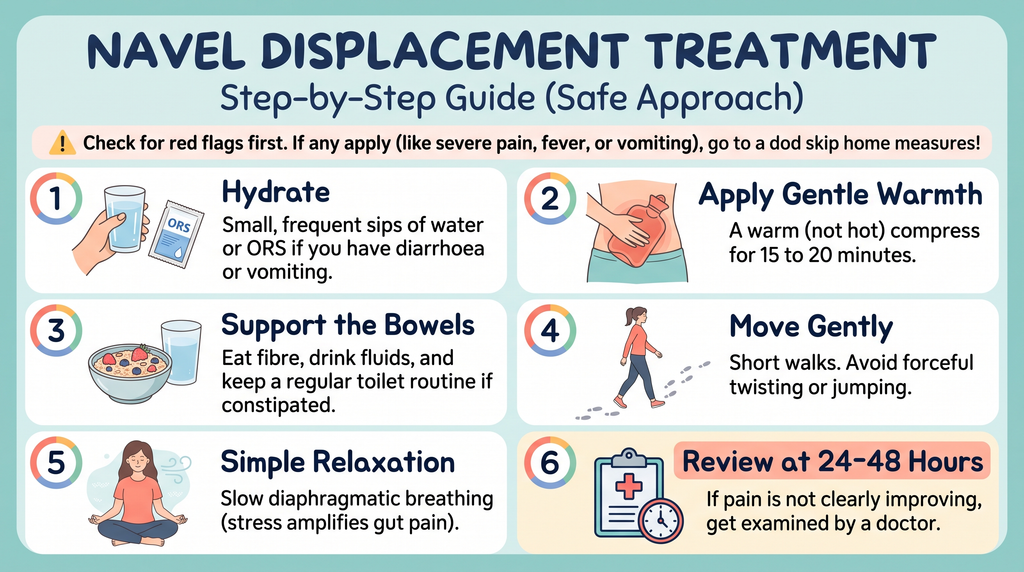
- Check for red flags first (see the section below). If any apply, go to a doctor and skip home measures.
- Hydrate with small, frequent sips of water or oral rehydration solution if you have diarrhoea or vomiting.
- Apply gentle warmth such as a warm (not hot) compress for 15 to 20 minutes.
- Support the bowels: fibre, fluids and a regular toilet routine if you are constipated.
- Move gently: short walks, not forceful twisting or jumping.
- Use simple relaxation: slow diaphragmatic breathing helps, because stress amplifies gut pain.
- Review at 24 to 48 hours. If pain is not clearly improving, get examined.
Navel Displacement Treatment Explained for Beginners: Two Approaches Compared
| Method A: Evidence-based assessment | Method B: Traditional manual “realignment” | |
| What happens | History, abdominal examination, targeted tests if needed, treatment of the actual cause | Pressure, cupping, jerking or jumping to “re-centre” the navel |
| Strengths | Finds appendicitis, hernia, infection and other treatable causes; clear follow-up | Familiar, comforting, often relaxing, low cost |
| Limits and risks | Takes a visit; may end in “reassuring, no serious cause” | No evidence the “displacement” exists; forceful manipulation can aggravate a hernia or an inflamed bowel and delays diagnosis |
My preference: I always start with Method A, because the cost of missing appendicitis or a strangulated hernia is far greater than the cost of a clinic visit. Once serious causes are excluded, I do not object to gentle, non-forceful traditional practices such as warmth, light massage or yoga if they help a patient feel better. I strongly discourage forceful jerking, jumping or deep pressure, especially in children, pregnant women, people with a bulge at the navel, and anyone with a recent surgery scar.
What About Navel Oiling (Pechoti or Nabhi Chikitsa)?
This is a related but separate trend. Healthline notes that the Pechoti method likely won’t cause anything to be absorbed through the navel, though massage and oil use may have other benefits. Experts quoted in fact-checks said there is no scientific evidence for it and that it is not documented in classic Ayurvedic texts. A warm oil massage around the belly is generally low risk if your skin tolerates it, but it won’t cure diabetes, blood pressure or liver disease, as some advertisements claim.
From My Clinical Experience: A Composite Case
A 34-year-old man came in with three weeks of dull pain around his navel after moving furniture. A local healer had “set his navel” twice, with relief lasting a day or two. He had also seen two practitioners who had called it gas.
On examination, the pain was reproducible when he tensed his abdominal wall (a “Carnett’s sign”), and there was a small, tender bulge at the navel that enlarged when he coughed. This was a small umbilical hernia with associated abdominal wall strain. Ultrasound confirmed it with no bowel trapped. I explained why the earlier manipulations had given only temporary relief, advised him to avoid heavy lifting, treated the muscle pain, and referred him for elective surgical repair. Six weeks later he was pain-free and, in his words, “relieved to finally have a real answer.”
The lesson: the pain was real, the explanation was incomplete, and the “fix” could have made it worse.
When to Seek Medical Help Immediately
Go to an emergency department or see a doctor the same day if you have:
- Severe or rapidly worsening abdominal pain
- Pain that moves to the lower right abdomen
- Fever, persistent vomiting, or inability to keep fluids down
- A firm, tender or discoloured bulge at the navel that will not go back in
- A rigid, hard abdomen
- Blood in the stool or black stools
- Pain in pregnancy
- A child who is inconsolable, lethargic or not passing urine
- Unexplained weight loss, jaundice, or pain waking you at night
Recovery Timeline (After a Cause Is Identified)
- Simple muscle strain or gas: often improves within days to 2 weeks.
- Constipation: typically improves in days with fluids, fibre and routine, but may need treatment.
- Gastroenteritis: usually settles within a few days.
- Functional pain or IBS: a longer-term condition that can be well managed with diet, stress management and sometimes medication, typically over weeks.
- Umbilical hernia: may need surgical repair, followed by a few weeks of restricted lifting.
Recurrence is common when the underlying cause (such as constipation, heavy lifting or stress) is not addressed.
Navel Displacement Treatment: Key Details and Facts
- It is a traditional concept, not a recognized medical diagnosis.
- The pain behind it is real and has identifiable causes.
- The “pulse test” is not a reliable diagnostic method.
- Most cases are benign and self-limiting, but a minority are surgical emergencies.
- Forceful manipulation is the main avoidable risk.
Frequently Asked Questions
References
- Drossman DA. Functional gastrointestinal disorders: history, pathophysiology, clinical features and Rome IV. Gastroenterology. 2016;150(6):1262-1279. doi:10.1053/j.gastro.2016.02.032
- The Healthy Indian Project. Fact check: “Navel displacement” (updated Jan 2024). https://www.thip.media/?p=21692
- Healthline. Pechoti method. https://www.healthline.com/health/pechoti
- The Quint (Fit). 5 yoga poses for navel displacement. https://www.thequint.com/amp/story/fit/5-yoga-poses-for-navel-displacement
- HandWiki. Navel displacement (descriptive entry on the traditional concept). https://handwiki.org/wiki/Chemistry:Navel_displacement
- The Healthy Indian Project. Fact check: Does oiling the navel help? (March 2024). https://www.thip.media/health-news-fact-check/fact-check-does-oiling-the-navel-help-get-rid-of-health-problems/59691/


