Medically reviewed by: Dr Rinku Sharma
Brown discharge without a period is one of the most common reasons women message my office. They usually write with a mix of confusion and low-grade dread. If that’s you, take a breath. In most cases, light brown discharge is harmless and easy to explain. In a few cases, it needs prompt attention. This guide helps you tell which situation you’re in.
Quick Answer: What Does Brown Discharge Mean?
Brown discharge is usually old blood that has oxidized on its slow way out of the uterus or cervix. Common non-period causes include ovulation spotting, implantation bleeding, early pregnancy, hormonal contraception, PCOS, perimenopause, and irritation of the cervix or vagina. Less common but important causes include ectopic pregnancy, miscarriage, infection, and abnormal changes in the lining of the uterus or the cervix.
So, is brown discharge normal? Often, yes. A little brown spotting before or after a period is a normal part of many women’s cycles. But brown discharge instead of a period, especially with pain, a positive test, or a long delay, should be checked by a qualified health provider.
Understanding Brown Discharge: Why Is It Brown?
Fresh blood is red because it is rich in oxygen. When blood leaves the uterus slowly, the hemoglobin oxidizes and turns light brown, dark brown, or even black. That is why brown spotting often shows up at the very start or end of a period, or as a light spot between cycles.
The color tells you the blood is older or moving slowly. It does not tell you the cause. Vaginal discharge that is brown is also often a mix of cervical mucus and a small amount of period blood, which is why it can look thin, sticky, or stringy. Fluid produced from the cervix changes throughout your menstrual cycle, so what looks “normal” for you may look different from your friend’s.
Why Do I Have Brown Discharge but No Period? Common Causes
Pregnancy-Related Causes
- Implantation bleeding: Light spotting when the embryo attaches to the uterine lining, usually about 6 to 12 days after ovulation. It often appears right before an expected period.
- Early pregnancy spotting: Hormone changes and extra blood flow to the cervix can cause light brown spotting.
- Threatened or early miscarriage: Brown discharge, sometimes with cramps.
- Ectopic pregnancy: A pregnancy that grows outside the uterus, usually in the fallopian tube. This is a medical emergency (see red flags below).
- After an abortion or pregnancy loss: Brown discharge can last for days to a few weeks as the uterus empties and heals. Heavy bleeding, fever, or a bad smell means you should call your doctor.
Hormonal and Cycle-Related Causes
- Ovulation spotting: A brief dip in estrogen around mid-cycle can cause light spotting.
- Hormonal contraception: Breakthrough bleeding is common in the first 3 to 6 months of the pill, patch, ring, implant, injection, or an IUD (intrauterine device).
- Polycystic ovary syndrome (PCOS): Irregular ovulation leads to unpredictable bleeding and long-standing irregular periods.
- Perimenopause: Changing estrogen and progesterone levels cause skipped periods and on-and-off spotting.
- Thyroid disorders and high prolactin: An underactive thyroid (hypothyroidism) or high prolactin can disrupt the hormone signals between the brain and the ovaries.
- Stress, major weight change, and intense exercise: These can pause ovulation and delay your period.
Structural and Local Causes
- Cervical ectropion: Soft glandular cells on the outer cervix that bleed easily, especially after sex.
- Cervical or endometrial polyps: Benign growths that cause spotting between periods.
- Uterine fibroids or adenomyosis: These more often cause heavy periods but can cause spotting.
- Retained foreign body: A forgotten tampon or condom can cause dark brown, foul-smelling discharge.
Infection and Abnormal Cell Changes
- Cervicitis and pelvic inflammatory disease (PID): Often caused by chlamydia or gonorrhea. Women who are sexually active and notice unusual discharge, itching, or a burning sensation should get tested.
- Endometrial hyperplasia, endometrial cancer, or cervical cancer: These are uncommon. But persistent abnormal bleeding is the most common symptom, so we never ignore it, especially after age 45 or with risk factors.
Can Brown Spotting Mean Pregnancy?
Yes, it can. If you are sexually active and your period is 7 days late, brown spotting may be an early sign of pregnancy. Some women also see brown discharge when they are planning for a baby, or after a fertility treatment such as IUI (intrauterine insemination), because of cervical irritation or implantation.
But brown spotting can also point to miscarriage or ectopic pregnancy. That’s why a pregnancy test should always come first. If the test is positive and you have any bleeding with pain, call your doctor the same day.
Do I Have Brown Discharge but No Period? Step-by-Step Guide: What to Do Right Now
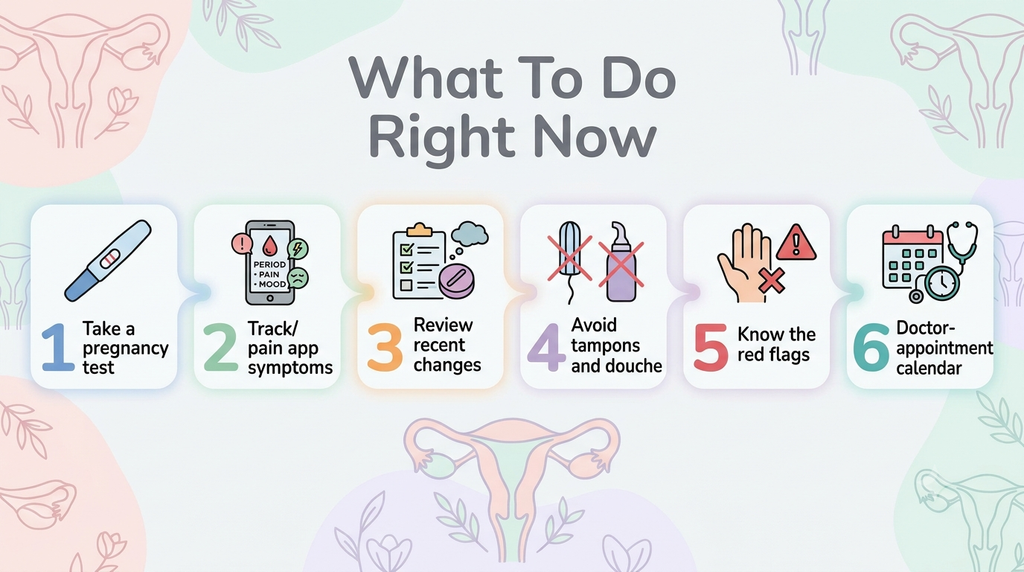
- Take a pregnancy test. If your period is late and you’ve had sex, this is step one. Use a urine pregnancy test. If it is negative but your period still hasn’t come yet, repeat it in 3 to 7 days.
- Track it. Write down the start date, the amount (pantyliner or pad), the color, any pain, cramp, odor, itching, or fever, and the date of your last period.
- Review recent changes. Think about new or missed birth control, emergency contraception, travel, illness, stress, medicine changes, and spotting after sex.
- Avoid tampons, douching, and vaginal products until you know the cause.
- Know the red flags (below) and get care right away if any apply.
- Book an appointment if spotting lasts more than 7 days, comes back for 2 to 3 cycles, or happens after menopause.
When to See a Doctor: Red Flags and Immediate Care
Go to urgent care or the emergency department if brown or red bleeding is accompanied by severe symptoms such as:
- Sharp or one-sided pelvic or belly pain
- Dizziness, fainting, or shoulder-tip pain (a possible sign of internal bleeding from an ectopic pregnancy)
- Soaking a pad every hour for 2 or more hours
- Fever, chills, or foul-smelling discharge
- A positive pregnancy test plus any bleeding with pain
Please don’t wait these out. A ruptured ectopic pregnancy can become life-threatening quickly.
What Discharge Colors Can Tell You
Brown is not the only color women ask about. Clear or transparent, stretchy discharge is usually normal and often appears around ovulation. White vaginal discharge that is thin and odorless is also normal. Thick, clumpy white discharge with itching may signal a yeast infection. Yellow or green discharge, a strong smell, or a burning sensation can point to infection and should be checked.
How I Evaluate It in Clinic
When a patient asks about brown discharge, I follow a clear diagnosis path:
- A review of your history and menstrual pattern (ACOG recommends treating the menstrual cycle as a vital sign)
- A urine or blood hCG test to rule out pregnancy
- A speculum and pelvic exam to look for ectropion, polyps, or a foreign body
- STI testing (NAAT for chlamydia and gonorrhea) and cervical cancer screening if you are due
- A transvaginal ultrasound to check the uterine lining, the ovaries, and any masses
- Blood tests: TSH, prolactin, and sometimes androgens or a CBC
- An endometrial biopsy if you’re 45 or older, or younger with ongoing bleeding plus risk factors such as obesity or long-term unopposed estrogen
The FIGO “PALM-COEIN” system is the framework we use to classify abnormal uterine bleeding (Munro et al., 2011; revised 2018).
Why Brown Discharge Is Often Misdiagnosed or Dismissed
Light spotting gets brushed off as “just stress,” and sometimes it is. But women are often reassured without a pregnancy test or exam. Early ectopic pregnancy is a classic example, since its symptoms can look like a light period. The reverse also happens: women are told “it’s probably hormones” for months when a polyp or infection is the real cause.
Clinical Note: The Hidden Toll of “Unpredictable” Bleeding
Patients rarely tell me the discharge itself is the worst part. It’s the uncertainty. They describe checking their underwear constantly, avoiding intimacy, skipping workouts, and lying awake wondering whether it’s a miscarriage or something worse. That constant watchfulness is exhausting and can feed anxiety and poor sleep, which in turn disrupts cycle regulation. Part of my treatment is giving you a clear plan and timeline so you can stop guessing.
From My Clinical Experience: Two Patient Journeys
Case 1: Months of Spotting and Dismissed Concerns
“Maya,” 32, came in after three months of on-and-off brown spotting and no true period. Her primary care provider had told her it was stress, and an urgent care clinic suggested she might be perimenopausal. She was scared, partly because she assumed something was seriously wrong, and partly because she felt dismissed.
Her pregnancy test was negative. Her ultrasound showed multiple small follicles at the edge of the ovaries and a normal uterine lining, and her labs showed high androgens with normal TSH and prolactin. The diagnosis was PCOS with anovulatory bleeding. We started a levonorgestrel IUD to protect the lining and control her cycle, and she worked on sleep, nutrition, and insulin sensitivity with a dietitian. At her 4-month follow-up, her spotting had stopped and her anxiety had dropped a lot. Her biggest comment: “I just wanted someone to tell me what was happening.”
Case 2: Irregular Periods and a Thyroid Problem
“Anita,” a 28-year-old woman with long-standing irregular periods, came in after five days of dark brown spotting. She had also started experiencing fatigue and weight gain. Her pregnancy test was negative. Her blood work showed she was diagnosed with hypothyroidism, and her ultrasound was normal. With thyroid treatment, her cycles became more regular over the next few months, and the brown spotting stopped.
Treatment Options: Why I Choose What I Choose
Treatment depends entirely on the cause.
| Cause | Option A | Option B | My preference and why |
| Anovulatory bleeding (e.g., PCOS) | Combined oral contraceptive | Cyclic progestin or LNG-IUD | If you also need birth control and have no migraine with aura or clot risk, I often start with a combined pill. For long-term lining protection with few effects on the rest of the body, I prefer an LNG-IUD. |
| Thyroid disorder | Thyroid hormone replacement | Treat other hormone causes | Correcting the thyroid often restores a regular cycle on its own. |
| Endometrial or cervical polyp | Watchful waiting | Hysteroscopic polypectomy | I prefer removal for polyps that cause symptoms or for women over 45, since it both diagnoses and cures. |
| Ectopic pregnancy | Methotrexate | Laparoscopic surgery | Methotrexate suits stable patients with low hCG and no rupture. Surgery is for instability or rupture. |
| nfection (cervicitis/PID) | Outpatient antibiotics | Inpatient IV therapy | Outpatient if you’re stable. Admission if the illness is severe, you are pregnant, or you can’t take pills. |
| Contraceptive breakthrough bleeding | Wait 3 to 6 months | Switch formulation | I counsel patients to give it time unless the bleeding is bothersome or unexpected. |
Recovery Timeline: What to Expect
- Days 1 to 3: Evaluation, pregnancy test, exam, and labs.
- Week 1: Results reviewed and treatment started if needed.
- Weeks 2 to 6: Hormonal treatments typically begin to regulate bleeding. Infections usually improve within days of antibiotics.
- Months 3 to 6: Contraceptive-related spotting commonly settles. PCOS management takes longer.
- Any time: Persistent or worsening bleeding means we reassess rather than wait.
Brown Discharge but No Period: Common Questions Answered
Is brown discharge before a missed period a sign of pregnancy?
It can be. Implantation bleeding and early pregnancy spotting are possible, but so are many other causes. A test is the only way to know.
Can stress cause brown discharge instead of a period?
Chronic stress can stop ovulation, which causes a late period and spotting. But I’d rule out other causes first.
How long is too long?
Spotting that lasts beyond 7 days, spotting that has gone on for the last 2 weeks, spotting that repeats for 2 to 3 cycles, or any bleeding after menopause deserves evaluation.
Brown Discharge but No Period: History and Background
In the past, abnormal bleeding was labeled with vague terms like “dysfunctional uterine bleeding.” In 2011, FIGO introduced the PALM-COEIN classification (Polyp, Adenomyosis, Leiomyoma, Malignancy/hyperplasia; Coagulopathy, Ovulatory dysfunction, Endometrial, Iatrogenic, Not yet classified) to standardize diagnosis. ACOG now also encourages clinicians to treat the menstrual cycle as a “vital sign,” reflecting how much a change in pattern can reveal about overall health.
Brown Discharge but No Period: Best Practices
- Don’t self-diagnose. Test for pregnancy first.
- Keep a symptom and cycle log (apps work fine).
- Stay current on cervical screening and STI testing.
- Avoid douching and scented products.
- Bring your log to your appointment with your gynecologist.
- Never ignore bleeding after menopause.
Frequently Asked Questions
References
- Munro MG, Critchley HOD, Fraser IS; FIGO Menstrual Disorders Committee. The two FIGO systems for normal and abnormal uterine bleeding symptoms and classification of causes. Int J Gynaecol Obstet. 2018;143(3):393-408.
- ACOG Committee Opinion No. 651. Menstruation in girls and adolescents: using the menstrual cycle as a vital sign. Obstet Gynecol. 2015.
- ACOG Practice Bulletin No. 193. Tubal ectopic pregnancy. Obstet Gynecol. 2018;131(3):e91-e103.
- ACOG Practice Bulletin No. 128. Diagnosis of abnormal uterine bleeding in reproductive-aged women. Obstet Gynecol. 2012;120(1):197-206.
- Teede HJ, et al. Recommendations from the 2023 international evidence-based guideline for the assessment and management of polycystic ovary syndrome. Fertil Steril. 2023.