Written from the perspective of a practising obstetrician-gynaecologist, for expectant parents.
If you were told at your 20-week scan that your placenta is “low-lying”, you probably went home and searched for answers within the hour. I understand that. It is one of the most common findings that turns a happy scan into a worried evening. Here is the most important thing I tell my patients: a low placenta at 20 weeks is usually a finding to monitor, not a diagnosis to fear. This guide explains what it is, how it behaves, and the warning signs that need prompt attention.
What Is a Low-Lying Placenta?
The placenta is the organ that forms in early pregnancy to deliver oxygen and nutrients to your baby. It implants in the endometrium of the uterus, usually in the fundus or the upper body of the uterus, well away from the cervix.
A low-lying placenta means the placental edge sits in the lower uterine segment, close to the internal cervical os (the inner opening of the cervix) but not covering it. In current UK guidance, the edge is within 20 mm of the os.
The terminology matters because management differs:
- Low-lying placenta: the edge lies less than 20 mm from the internal os, without covering it.
- Placenta praevia (previa): the placenta lies directly over the internal os.
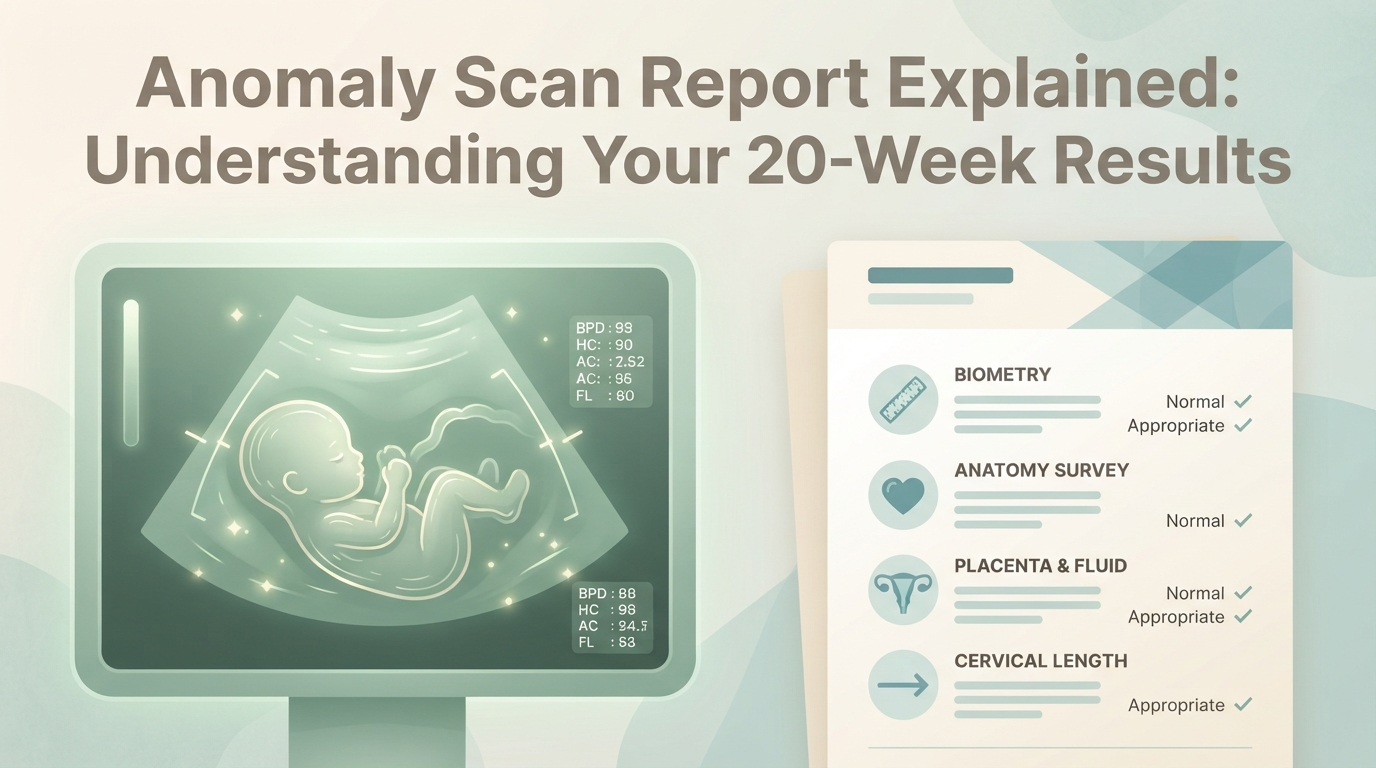
At the routine anomaly scan (roughly 18+6 to 21+6 weeks), the placenta is located as part of standard care. This is how most low-lying placentas are found, usually in women with no symptoms at all.
Low-Lying Placenta Key Details and Facts
- Common finding: Educational summaries commonly cite around 5–10% of women having a low placenta at the mid-pregnancy scan. The vast majority resolve as the pregnancy advances.
- Persistent praevia is much less common: Placenta praevia at term is often quoted at about 1 in 200 pregnancies.
- Usually painless: The classic warning sign is sudden, bright-red vaginal bleeding without pain.
- Scan is key: A transvaginal ultrasound (TVS) measures the distance between the placental edge and the internal os more accurately than an abdominal scan, and it is safe.
- Delivery plan depends on distance, not just the label: how far the edge sits from the os at the late scan largely determines whether vaginal birth is reasonable.
How Does a Low-Lying Placenta Work? (Why It “Moves”)
Your placenta does not physically crawl upward. What changes is the uterus itself.
As pregnancy advances, the lower uterine segment (the stretchy region above the cervix) elongates and thins. The upper uterus grows faster than the lower part, so the placental edge’s relationship to the cervix shifts. The placenta also tends to grow preferentially towards the better-vascularised upper uterine wall, a process called trophotropism. The result is that the edge appears to “migrate” away from the os on later scans.
Migration is less reliable in some situations:
- When the placenta lies on the anterior wall, particularly over a previous caesarean scar
- When the placenta already covers the os at the mid-pregnancy scan
- When the uterine scar has altered how the lower segment stretches
This is why we rescan rather than assume.
Causes and Risk Factors
We often cannot pinpoint why a placenta implanted low in a given pregnancy. Recognised associations include:
- Previous caesarean delivery (risk rises with the number of caesareans)
- Previous placenta praevia
- Multiple pregnancy (twins or more)
- Assisted reproductive technology (IVF)
- Advanced maternal age
- Smoking
- Prior uterine surgery, such as myomectomy or dilatation and curettage
- Multiparity (several previous births)
A risk factor is not a cause, and many women with a low-lying placenta have none of these.
Symptoms: What You May (and May Not) Notice
Many women feel nothing. If symptoms occur, they include:
- Painless, bright-red vaginal bleeding, often in the second or third trimester
- Bleeding after sex or a vaginal examination
- Uterine tightenings or contractions with bleeding
- Malpresentation late in pregnancy (breech or transverse lie), because the low placenta occupies space the baby’s head would normally use
Do not attempt a home vaginal examination, and avoid tampons and vaginal intercourse, if you have been told your placenta is low (see “Reality Check” below).
Why a Low-Lying Placenta Is Sometimes Misdiagnosed or Misunderstood
Misunderstanding is common, and it is not always the patient’s or clinician’s fault:
- Abdominal scan limitations. A full maternal bladder can compress the lower uterine segment and make a normal placenta look low or praevia. TVS resolves this. TVS is considered safe, and the probe does not enter the cervical canal.
- Inconsistent definitions. Many centres still use variable ultrasound criteria for diagnosing praevia, even though the RCOG recommends a standardised TVS-based approach.
- Wording that frightens. “Placenta praevia” and “low-lying” are sometimes used interchangeably in conversation, though the implications differ.
- Early scans. A placenta that looks low at 12–16 weeks says very little, because the lower segment has not yet formed properly.
- Missed relationship with a scar. In women with prior caesareans, an anterior low placenta needs careful assessment for placenta accreta spectrum (abnormal adherence). More than 90% of accreta cases occur in women with a previous caesarean, typically with an anterior low-lying placenta or praevia.
Low-Lying Placenta Step-by-Step Guide: What Happens From Diagnosis to Delivery
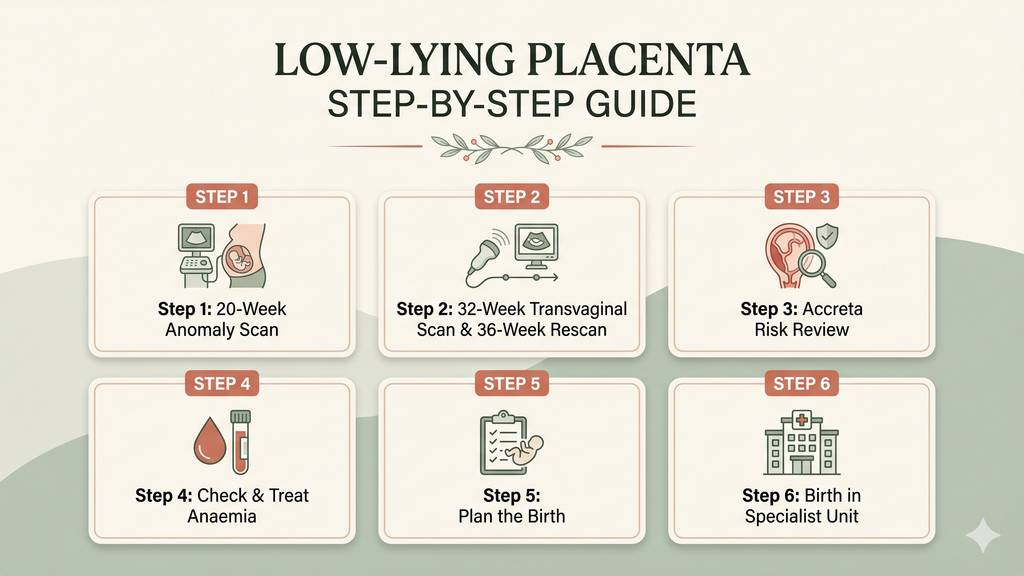
Step 1: The 20-week anomaly scan. The placental position is recorded. If the edge is within 20 mm of the os, or covers it, you are flagged for follow-up.
Step 2: Repeat transvaginal scan at 32 weeks. For women whose low-lying placenta or praevia persists at the mid-pregnancy scan, RCOG guidance recommends a follow-up scan including TVS at 32 weeks . Many hospital protocols add a further scan at around 36 weeks if it still has not resolved.
Step 3: Review for accreta risk. If you have had a previous caesarean and the placenta is anterior or low, I look specifically for signs of placenta accreta spectrum and refer to a specialist unit if needed.
Step 4: Check and treat anaemia. Iron levels matter more if bleeding is a risk, because they determine how well you tolerate any blood loss.
Step 5: Plan the birth. This depends on the distance between the placental edge and the os at the final scan (see the comparison below).
Step 6: Birth in the right place. Delivery should be in a unit with on-site blood transfusion and access to critical care.
Treatment and Management Options: Vaginal Birth vs Caesarean, and Why I Choose What I Choose
There is no “operation to fix” a low-lying placenta. Management is about monitoring and planning the safest birth.
Option A: Planned vaginal birth
When I consider it: an asymptomatic woman whose placental edge at the late scan lies at a safe distance from the os. In RCOG guidance, the mode of delivery for a third-trimester asymptomatic low-lying placenta is individualised, and edges that have moved clear are generally compatible with attempting vaginal birth, based on the measured distance and clinical picture.
Advantages: avoids major abdominal surgery, shorter recovery, and no scar to worry about in future pregnancies.
Drawbacks: the labour may need to be abandoned if bleeding starts, so I make sure the unit is ready for urgent conversion.
Option B: Planned caesarean birth
When I recommend it: the placenta still lies over the os (praevia), or the edge remains very close to it. A planned caesarean is typically scheduled in the late-preterm to early-term window (many protocols use 36+0 to 37+0 weeks) to reduce the chance of emergency bleeding before labour starts.
Advantages: controlled setting, an anaesthetic team and blood products ready.
Drawbacks: recovery is longer, the repeat-caesarean risks accumulate in later pregnancies, and in a praevia the incision may pass through or near the placenta.
Why I choose between them
My decision rests on four variables: the measured distance to the os, whether the placenta is anterior or posterior, any bleeding history, and whether there is a previous scar. A woman with a posterior placenta clear of the os who has never bled is a very different patient from one with an anterior placenta over a caesarean scar. A vaginal examination should never be done until the position is known to be safe.
If you bleed during pregnancy
Bleeding means urgent hospital assessment. Management may include admission, blood tests and group-and-save, fetal monitoring, and antenatal corticosteroids to mature the baby’s lungs if early delivery is likely. Tocolysis (medication to slow contractions) may be considered for up to 48 hours to allow steroids to work in symptomatic cases. Tailoring care, including hospital stay, to individual circumstances is advised.
A Real Patient’s Journey (From My Clinical Experience)
“Meera” (name changed), 34, was pregnant with her second baby and had a previous caesarean for a breech presentation. Her 20-week scan showed an anterior low-lying placenta, with the edge about 12 mm from the os.
The struggle. Her first scan report simply read “placenta praevia”, and she spent two weeks believing she would need an emergency operation. A friend told her she must lie flat for months. Her GP, understandably cautious, advised “no activity at all”.
What we did. A repeat TVS at 32 weeks showed the edge had moved to roughly 25 mm from the os, so it no longer met the low-lying definition. Because of her uterine scar, I still reviewed the images carefully for signs of abnormal adherence, and there were none. Her iron levels were low, so we treated her anaemia. At 36 weeks a final scan confirmed the position.
Outcome. After counselling about vaginal birth after caesarean (VBAC) versus repeat caesarean, she chose a planned repeat caesarean at 39 weeks. Her baby was healthy, and she went home on day three.
What I took from it. The initial label caused far more distress than the condition ultimately did. Clear terminology and a scan schedule can change a patient’s whole experience.
🩺 Clinical Note: Life With a Low-Lying Placenta
The physical risk is rarely what patients describe first. It’s the hypervigilance. Every trip to the bathroom becomes a check for blood. Women often tell me they stop exercising, avoid travel, struggle to sleep, and feel anxious around intimacy, sometimes for months. I also see appetite and mood affected by the uncertainty. If this sounds like you, say so at your appointment. Anxiety is a legitimate part of the clinical picture, and a clear scan plan, plus a named person to call, reduces it substantially.
Reality Check: Risks, Recovery, and When to Seek Help Immediately
Honest risks if the placenta stays low or covers the os:
- Antepartum haemorrhage (bleeding before birth)
- Preterm birth, whether from bleeding or a planned early delivery
- Postpartum haemorrhage, because the lower segment contracts less efficiently
- Need for blood transfusion
- Rarely, placenta accreta spectrum, particularly with a prior caesarean, which can lead to hysterectomy
Seek emergency care immediately if you have:
- Any vaginal bleeding, even light spotting, after about 20 weeks
- Bleeding with abdominal pain, contractions or tightening
- Reduced fetal movements
- Dizziness, faintness, or a racing heart
Do not wait to see whether it settles, and do not drive yourself if you feel faint.
What to avoid while the placenta is low: vaginal intercourse, tampons or douching, and vaginal examinations by anyone unaware of your diagnosis. Whether you need activity restriction is individual. Many women with an asymptomatic low-lying placenta can carry on normal daily life, and I advise on this case by case.
Recovery Timeline After Delivery
- First 24 hours: monitoring for bleeding; early mobilisation after a caesarean.
- Days 1–3: pain relief, wound care, feeding support, and a check of haemoglobin.
- Weeks 1–2: rest, hydration, iron supplements if anaemic; watch for fever, heavy bleeding, or wound redness.
- Weeks 2–6: gradual return to activity; vaginal birth usually recovers faster than caesarean.
- Six-week review: a check on your recovery, mood, and plans for future pregnancies.
Low-Lying Placenta: Common Questions Answered
What is a low-lying placenta?
A placenta whose edge lies within 20 mm of the internal cervical os without covering it.
Will it move?
In most women, yes. The lower segment of the uterus lengthens as pregnancy advances, and most low placentas found at 20 weeks no longer qualify as low by the third trimester. Migration is less reliable if the placenta is anterior, covers the os, or lies over a caesarean scar.
Can I have a normal delivery?
Often yes, if the repeat scan shows the edge has moved sufficiently clear of the os and you have no bleeding. Your obstetric team will decide based on the measured distance .
Is it my fault?
No. Nothing you did, such as lifting, exercising or stress, causes a low placenta.
Frequently Asked Questions
References
- Jauniaux ERM, Alfirevic Z, Bhide AG, et al. Placenta Praevia and Placenta Accreta: Diagnosis and Management. RCOG Green-top Guideline No. 27a. BJOG. 2018. doi:10.1111/1471-0528.15306
- NHS Wales / Powys Health Board. Placental anomaly guideline, citing RCOG 2018 (mid-pregnancy placental localisation; incidence of praevia at term). wisdom.nhs.wales
- Jauniaux E, et al. The placenta and umbilical cord in prenatal care: unseen, overlooked and misunderstood. (Review discussing TVS and RCOG protocol.) PMC11612610. ncbi.nlm.nih.gov/pmc/articles/PMC11612610
- Silver RM, Landon MB, Rouse DJ, et al. Maternal morbidity associated with multiple repeat cesarean delivery. Obstet Gynecol. 2006;107(6):1226–32.
- Royal College of Obstetricians and Gynaecologists. Placenta Praevia and Placenta Accreta Spectrum: Diagnosis and Management. Green-top Guideline No. 27a, fifth edition. BJOG. 2026;133(10).
- Clinical education summary of RCOG guidance (prevalence at the 20-week scan, 32- and 36-week rescans, timing of planned delivery). iatrox.com/academy/ukmla/placenta-praevia