Internet gaming & video gaming addiction refers to a pattern of persistent, excessive, and poorly controlled gaming behavior that results in psychological distress, functional impairment, or social and academic decline.
Although internet gaming addiction and video gaming addiction are often used interchangeably in public discourse, clinically they represent overlapping but not identical behavioral patterns.
- Internet gaming addiction: It primarily involves online, network-based games that include social interaction, competitive ranking, and continuous progression systems.
- Video gaming addiction: It may also include offline or console-based gaming, where compulsive behavior develops even without online interaction.
Modern clinical frameworks recognize both patterns under the broader umbrella of internet gaming & video gaming disorder, when the behavior meets specific diagnostic thresholds and causes measurable harm.
The World Health Organization (WHO) includes Gaming Disorder in the ICD-11 as a recognized behavioral health condition. The American Psychiatric Association (APA) also acknowledges Internet Gaming Disorder in the DSM-5 (Section III), indicating that the condition is supported by scientific research but continues to be evaluated to establish clearer and more consistent diagnostic guidelines.
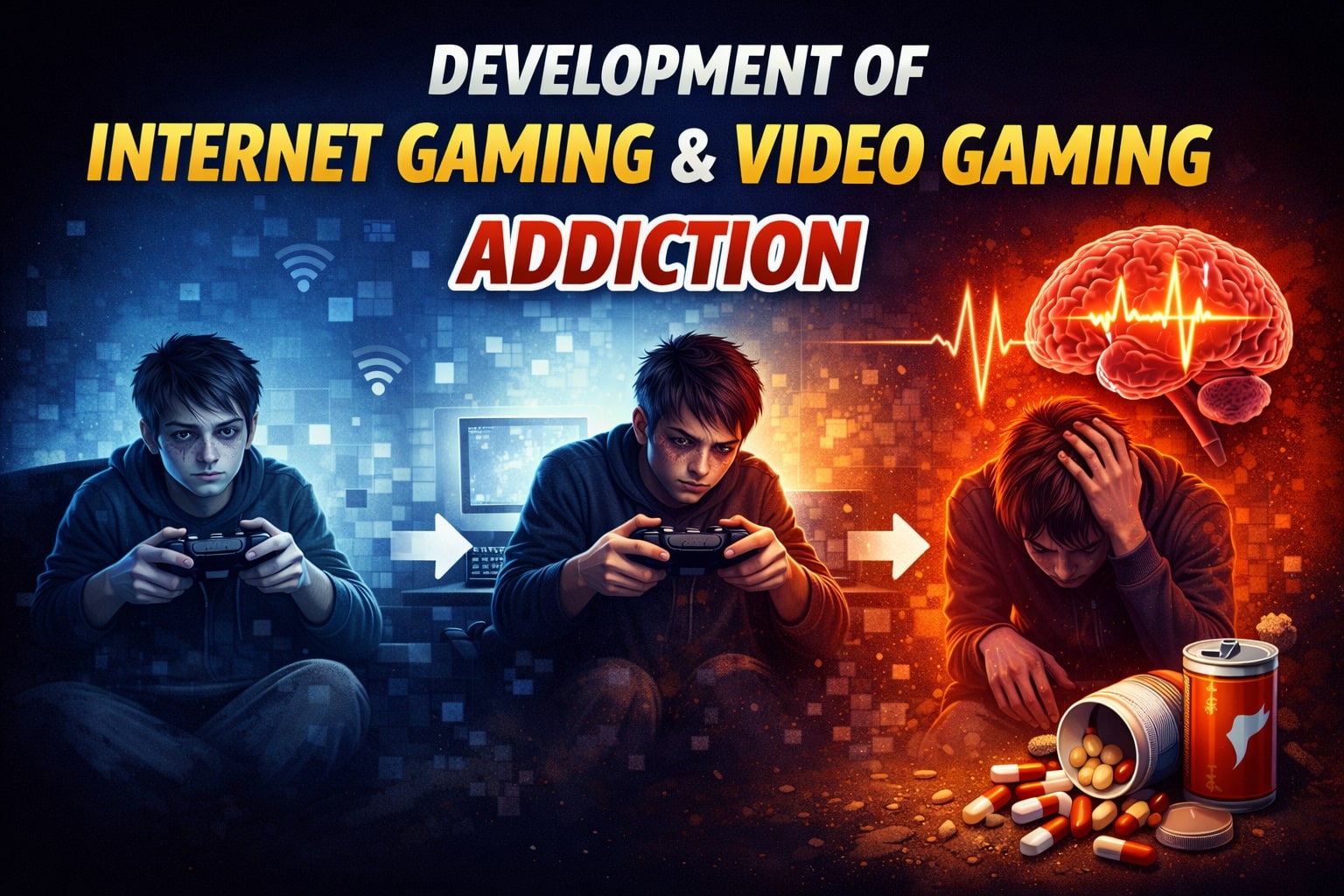
Development of Internet Gaming & Video Gaming Addiction
Internet gaming & video gaming addiction does not appear suddenly. In clinical observation, it typically develops through progressive behavioral reinforcement, influenced by neurobiology, environment, and emotional coping patterns.
Online Games:
- Variable reward schedules
- Social validation systems
- Achievement-based progression
- Competitive ranking
These elements repeatedly stimulate dopaminergic reward pathways, reinforcing prolonged engagement. Over time, some individuals experience:
- Reduced interest in non-gaming activities
- Increasing time spent gaming to achieve the same satisfaction
- Irritability or restlessness when unable to play
Research published in behavioral addiction literature confirms that behavioral addictions share neurofunctional similarities with substance-related disorders, although they are clinically distinct.
Importantly, most gamers do not develop addiction. The disorder emerges when gaming becomes the primary coping mechanism for stress, anxiety, or emotional discomfort.
Scientific Background and Research Evolution
Research on internet gaming & video gaming addiction dates back to the early 1980s, when problematic gaming behavior was first documented in academic studies. During the 1990s and early 2000s, researchers expanded this work to include internet-based gaming and behavioral addiction patterns, identifying loss of control and functional impairment in a small subset of users.
In 2013, the American Psychiatric Association (APA) formally introduced Internet Gaming Disorder in the DSM-5 as a condition requiring further study. Continued global research led the World Health Organization (WHO) to recognize Gaming Disorder in the ICD-11 in 2018, confirming it as a clinically relevant, research-supported behavioral health condition.
Internet Gaming & Video Gaming Disorder: Clinical Recognition
DSM-5 Perspective (APA)
The DSM-5 outlines Internet Gaming Disorder using nine proposed criteria, including:
- Preoccupation with gaming
- Loss of control
- Withdrawal-like symptoms
- Continued gaming despite psychosocial problems
A diagnosis is considered when multiple criteria persist for 12 months, though DSM-5 classifies IGD as a research condition rather than a finalized diagnosis.
ICD-11 Perspective (WHO)
The WHO defines Gaming Disorder using three core features:
- Impaired control over gaming
- Increasing priority given to gaming
- Continuation despite negative consequences
This recognition underscores that gaming addiction is a medical and behavioral health issue, not a moral failing.
What Are the Effects of Internet Gaming & Video Gaming Addiction?
Psychological and Emotional Effects
Clinical studies associate problematic gaming with:
- Anxiety and mood disturbances
- Emotional dysregulation
- Increased irritability
- Reduced stress tolerance
Comorbidity with depression, ADHD, and social anxiety is well documented in peer-reviewed research.
Cognitive and Functional Effects
Patients may show:
- Reduced attention span
- Impaired executive function
- Academic or occupational decline
- Disrupted sleep-wake cycles
These effects are often reversible with early intervention, especially in adolescents and young adults.
Social Effects
Families frequently report:
- Withdrawal from real-world relationships
- Communication breakdown
- Increased conflict
- Loss of interest in previously valued activities
How Common Is It? Prevalence Across Age Groups
Prevalence estimates vary due to diagnostic differences, but global research indicates that a minority of gamers develop clinically significant addiction, with higher vulnerability in specific age groups.
Adolescents
Adolescents are particularly vulnerable due to:
- Ongoing brain development
- Heightened reward sensitivity
- Limited impulse control
WHO-aligned studies suggest adolescents represent the highest-risk group, though still a minority overall.
Young Adults
University students and young professionals frequently present with:
- Academic decline
- Sleep deprivation
- Emotional dependency on gaming
This group often uses internet gaming as a coping mechanism for stress or identity pressure.
Adults
Adult cases are less common but increasingly observed, often linked to:
- Occupational stress
- Social isolation
- Underlying mood disorders
Risk Factors Identified in Research
Evidence-based risk factors include:
- Early unsupervised exposure
- Poor emotional regulation skills
- High impulsivity traits
- Coexisting mental health conditions
- Limited offline social support
Research published in journals including JHSMR emphasizes that gaming itself is not the cause the disorder emerges when gaming replaces adaptive coping strategies.
Real-Life Clinical Experience at Amcare Hospital
Case Observation: Aryan, 23-Year-Old College Student

Aryan , a 23-year-old college student, was evaluated at Amcare Hospital following concerns raised by his family regarding noticeable changes in his daily functioning and behavior over the preceding two years.
According to both Aryan and his caregivers, he initially engaged in multiple internet and offline video based gaming as a recreational activity to cope with academic pressure. Gradually, the frequency and duration of gaming increased, eventually occupying a significant portion of his waking hours.
At the time of assessment, Aryan reported spending approximately 8 to 10 hours per day engaged in gaming, with a tendency to extend sessions late into the night.
Clinical Observations Noted During Evaluation
- Decline in academic performance compared to previous semesters
- Persistent disturbance of sleep patterns, including delayed sleep onset
- Irritability and restlessness when gaming sessions were interrupted
- Reduced participation in offline social and family interactions
During the clinical interview, Aryan described gaming as the primary activity that provided a sense of calm and emotional relief. He acknowledged repeated unsuccessful attempts to reduce gaming time despite awareness of its negative impact on his studies, sleep, and interpersonal relationships. This impaired control over gaming behavior was considered a clinically relevant finding.
Based on structured assessment and clinical judgment, Aryan demonstrated behavioral patterns consistent with Internet Gaming Disorder as described in DSM-5 research criteria, including preoccupation, loss of control, and continuation despite adverse consequences. However, at the time of presentation, the duration and severity of impairment did not fully satisfy all diagnostic requirements for ICD-11 Gaming Disorder, which necessitates sustained and marked functional impairment.
Clinical Interpretation
From a specialist perspective, Aryan’s presentation represented an early to intermediate stage of internet gaming addiction, rather than an advanced or crisis-level disorder. Early intervention strategies were therefore recommended to prevent progression toward more entrenched behavioral patterns and long-term functional impairment.
This case illustrates a commonly observed clinical trajectory in young adults, where problematic internet gaming evolves gradually and is often identified only after noticeable academic, sleep, or behavioral disruption, underscoring the importance of timely clinical evaluation rather than delayed intervention.
Preventive Measures for Caretakers and Families
Prevention focuses on early recognition and supportive boundaries, not punishment or confrontation.
Key Preventive Strategies :
- Encourage balanced routines (sleep, physical activity, offline hobbies)
- Maintain open, non-judgmental communication
- Monitor functional impact rather than screen time alone
- Seek professional assessment if behavior causes distress or impairment
WHO and APA-aligned guidance emphasizes that supportive involvement by caregivers significantly improves outcomes.
Diagnosis of Internet Gaming Addiction / Internet Gaming Disorder
The diagnosis of internet gaming addiction, also referred to in clinical and research settings as Internet Gaming Disorder, is based on a structured clinical assessment, rather than the amount of time an individual spends gaming.
Clinicians evaluate whether an individual demonstrates difficulty controlling gaming behavior, such as repeated unsuccessful attempts to reduce or stop gaming, increasing preoccupation with gaming, and the tendency to prioritize gaming over academic, occupational, or social responsibilities.
A key diagnostic feature is the continuation of gaming despite awareness of negative consequences, including declining academic performance, disrupted sleep patterns, strained relationships, or emotional distress.
For a diagnosis to be considered, these patterns must be persistent over time, typically for at least 12 months and must cause significant impairment in one or more areas of life. This requirement helps differentiate recreational or intensive gaming from a clinically relevant disorder. Standardized screening tools based on DSM-5 criteria may be used to support the evaluation, but they do not replace clinical judgment, which remains central to diagnosis.
Importantly, diagnosis also involves ruling out other primary conditions such as mood disorders, anxiety disorders, or attention-deficit disorders, ensuring that gaming behavior is not merely a symptom of another underlying issue.
When these diagnostic principles are applied consistently, internet gaming addiction is recognized as a real, identifiable, and manageable behavioral health condition.
Conclusion
Scientific consensus from the World Health Organization (WHO), the American Psychiatric Association (APA), and peer-reviewed journals including JHSMR confirms that internet gaming and video gaming–related disorders are real, measurable, and manageable conditions when identified early and addressed through evidence-based care.
This consensus is further reflected in real-world clinical practice, including cases evaluated and managed at Amcare Hospital, where similar patterns of internet gaming addiction have been clinically observed and diagnosed using established diagnostic frameworks.
This article is intended for public education and awareness, grounded in real clinical observation and current medical understanding.
Written By: Dr. Dinesh Verma (Neurosurgery & Intervention Neurology Amcare Hospital)
Reviewed By: Dr. Oshin Mantro (Senior Consultant Neurology Amcare Hospital)
FAQ,S: