Dengue fever, a mosquito-borne viral infection, affects millions worldwide each year. While many people experience mild symptoms of dengue fever that resolve on their own, approximately 5% of patients develop severe dengue, a life-threatening condition requiring immediate medical intervention.
Recognizing dengue alarming symptoms early can mean the difference between complete recovery and potentially fatal complications.
Understanding Dengue Alarming Signs
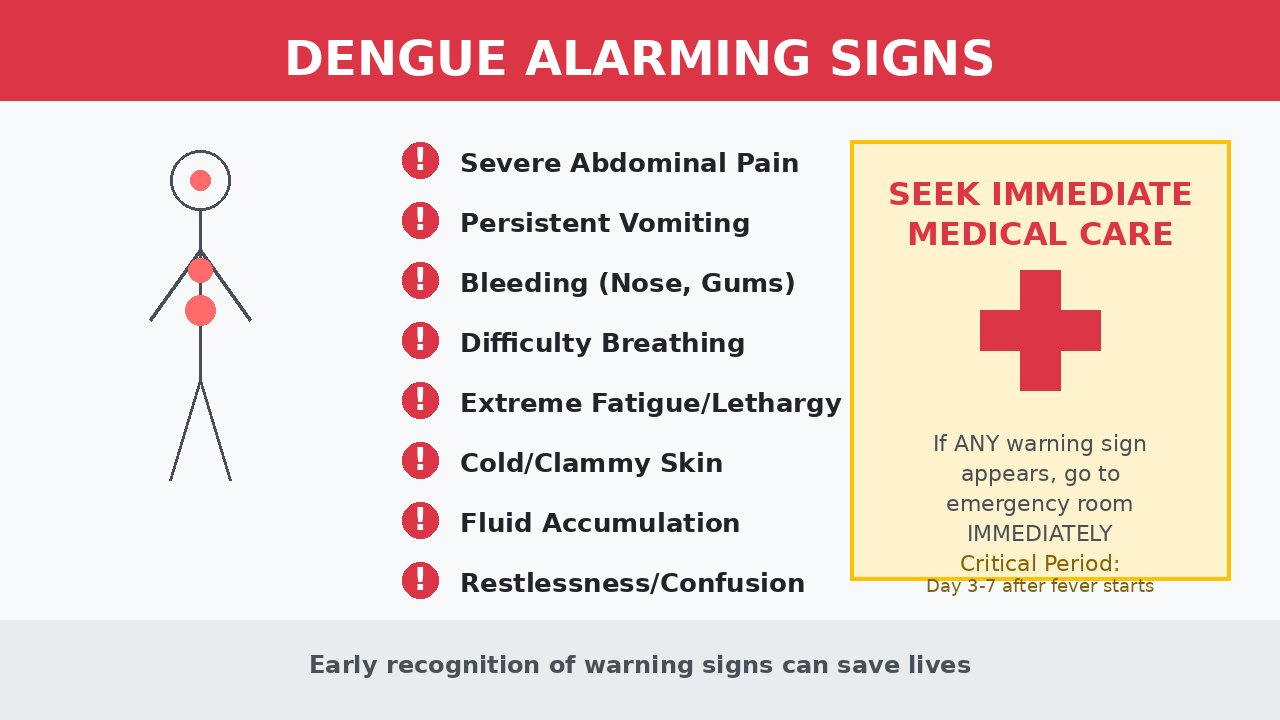
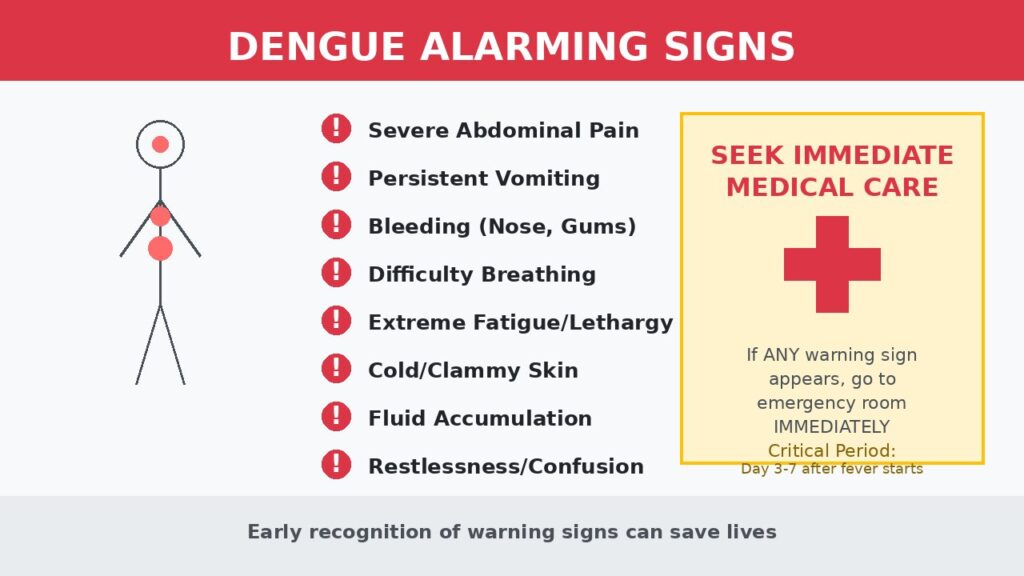
Dengue alarming signs, also called warning signs of dengue, typically appear 3-7 days after initial symptom onset, coinciding with the critical phase when fever begins to subside. This deceptive improvement often leads patients to believe recovery is underway, making vigilance during this period absolutely crucial.
Primary Warning Signs of Dengue:
- Severe abdominal pain or tenderness – Intense, persistent pain that doesn’t respond to common remedies, indicating potential plasma leakage or liver enlargement.
- Persistent vomiting – Three or more episodes within 24 hours that prevents fluid intake and accelerates dehydration.
- Clinical fluid accumulation – Difficulty breathing, chest discomfort, or abdominal distension from fluid in body cavities.
- Mucosal bleeding – Nosebleeds that won’t stop, bleeding gums, blood in vomit or stool, or unusually heavy menstrual bleeding.
- Lethargy or restlessness – Unusual drowsiness, difficulty waking, confusion, or extreme irritability indicating inadequate blood flow to the brain.
- Liver enlargement – Right upper abdominal fullness or discomfort detected during physical examination.
- Rapid breathing or difficulty breathing – Shortness of breath indicating fluid in lungs or shock.
- Cold or clammy extremities – Cold, pale hands and feet with weak pulse suggesting circulatory compromise and potential dengue shock syndrome.
- Bleeding under the skin – Small red or purple spots, larger purple patches, or extensive bruising without trauma.
If you or someone you know develops any of these warning signs, seek immediate emergency medical care. These symptoms indicate progression to severe dengue requiring hospitalization and intensive monitoring.
How Is Dengue Fever Transmitted
Understanding dengue fever transmission helps prevent infection and control outbreaks effectively. Dengue is transmitted primarily through bites from infected Aedes aegypti and Aedes albopictus mosquitoes.
These mosquito-borne diseases spread when mosquitoes bite an infected person and subsequently bite susceptible individuals, transmitting the virus through their saliva.
Key Transmission Facts:
- Daytime biters – Aedes mosquitoes are aggressive daytime feeders with peak activity during early morning and late afternoon, unlike malaria mosquitoes that bite at night.
- Indoor and outdoor breeding – These mosquitoes breed in clean, stagnant water in artificial containers around homes, flowerpots, water tanks, discarded tires, blocked gutters.
- Limited flight range – Mosquitoes typically fly only 400 meters from breeding sites, meaning transmission occurs in highly localized areas.
- Transmission cycle – The virus incubates in mosquitoes for 8-12 days after biting an infected person, then the mosquito remains infectious for its entire lifespan (2-4 weeks).
Non-Vector Transmission:
- Pregnant women can transmit dengue to their fetus, particularly near delivery.
- Rare transmission through blood transfusions and organ transplants in endemic areas.
- No person-to-person spread through casual contact, touching, or sharing food.
What Age Group Is Most Affected by Dengue Fever
Dengue fever affects all age groups, but certain populations face higher infection rates and complication risks.
Children and Adolescents:
In regions where dengue is endemic (Southeast Asia, South Asia, Latin America), children aged 5-15 years experience the highest disease burden. Dengue fever symptoms in child patients include high fever, extreme fussiness or lethargy, refusal to eat or drink, persistent vomiting, rash, and bleeding manifestations.
Children who contracted dengue previously face significantly higher risk of severe disease with subsequent infections involving different dengue serotypes due to antibody-dependent enhancement.
Adults:
Dengue fever in adults is increasing in areas with emerging or epidemic transmission. Older adults (over 60 years) face elevated complication and mortality risks due to underlying chronic conditions like diabetes, hypertension, and cardiovascular disease.
Adults working outdoors, construction workers, agricultural laborers, military personnel face higher exposure to Aedes mosquitoes.
Geographic Variations:
In endemic areas with continuous transmission, children bear the highest burden because adults have typically acquired immunity. In epidemic outbreaks, all age groups remain susceptible. International travelers and people moving to endemic areas face high infection risk regardless of age due to complete lack of immunity.
How Dangerous Is Dengue Fever
Dengue fever’s danger varies dramatically based on several factors, ranging from mild self-limited illness to potentially fatal disease.
Disease Severity Spectrum:
- Uncomplicated dengue fever (approximately 75% of symptomatic cases) – High fever, severe headache, pain behind eyes, muscle and joint pain, nausea, vomiting, and rash. Resolves within 7-10 days with supportive care.
- Severe dengue (approximately 5% of symptomatic cases) – Characterized by plasma leakage, hemorrhage, or organ impairment. Without proper care, mortality reaches 20%; with intensive care, mortality drops below 1%.
Life-Threatening Complications:
- Dengue shock syndrome – The most dangerous complication where plasma leakage depletes circulatory volume, causing weak pulse, cold clammy skin, restlessness, and altered consciousness. Requires immediate fluid resuscitation; delayed treatment results in multi-organ failure and death.
- Severe hemorrhage – Massive bleeding from gastrointestinal tract, intracranial bleeding, or other sites can be fatal, requiring blood product transfusions.
- Organ impairment – Damage to liver, kidneys, heart, and brain carries significant mortality risk.
Factors Increasing Danger:
- Secondary dengue infection with different serotypes increases severe disease risk.
- Co-existing health conditions (diabetes, hypertension, chronic kidney disease) increase complications.
- Pregnancy poses risks including miscarriage and premature delivery.
- Delayed medical care substantially increases mortality risk
Global Impact: The World Health Organization estimates 390 million dengue infections occur annually worldwide, with approximately 500,000 severe cases requiring hospitalization and 25,000 deaths—predominantly children in endemic countries.
How Is Dengue Fever Diagnosed and Treated
Accurate dengue fever diagnosis and treatment requires clinical assessment, laboratory testing, and appropriate supportive care.
Dengue Fever Diagnosis:
Clinical Diagnosis – Physicians suspect dengue in patients from endemic areas presenting with acute fever plus severe headache, retro-orbital pain, muscle pain, joint pain, rash, or hemorrhagic manifestations.
Laboratory Testing:
- Complete Blood Count (CBC) – Reveals progressive low white blood cells, low platelets (typically below 100,000/μL), and rising hematocrit indicating plasma leakage.
- NS1 Antigen Test – Detects dengue viral protein during early infection (days 1-7), providing rapid diagnosis in 15-30 minutes.
- Dengue IgM/IgG Antibodies – IgM antibodies appear from day 4-5 onward confirming recent infection; IgG indicates past infection.
- RT-PCR – Detects viral RNA during acute phase (first 5 days), providing definitive diagnosis and serotype identification.
- Liver Function Tests – Elevated enzymes suggest potential liver involvement
Dengue Fever Treatment:
Currently, no specific antiviral medication exists for dengue. Treatment focuses on supportive care and appropriate fluid management.
Outpatient Management (Uncomplicated Dengue):
- Oral rehydration – Aggressive fluid intake (2-3 liters daily for adults) with water, oral rehydration solutions, fruit juices, coconut water.
- Fever management – Paracetamol (acetaminophen) only. Aspirin, ibuprofen, and NSAIDs are absolutely contraindicated as they increase bleeding risk.
- Rest – Adequate bed rest during acute phase.
- Monitoring – Daily assessment for warning signs; seek emergency care immediately if they develop.
Hospital Management (Severe Dengue):
- Intravenous fluid therapy – Careful fluid resuscitation with crystalloid solutions; precise management prevents shock while avoiding pulmonary edema.
- Intensive monitoring – Frequent vital signs, hourly urine output, serial hematocrit measurements every 4-6 hours.
- Blood product transfusion – Reserved for active severe bleeding or critically low platelet counts (below 10,000-20,000/μL).
- Complication management – Mechanical ventilation for respiratory failure, vasopressors for shock, dialysis for kidney injury.
Recovery Phase: After the critical phase (day 7-10), patients enter recovery with spontaneous improvement, stabilizing vital signs, and rising platelet counts. Complete recovery typically occurs within 2-3 weeks.
Preventive Measures of Dengue Fever
Prevention of dengue requires integrated approaches targeting mosquito vectors and virus transmission.
Personal Protective Measures:
- Mosquito repellents – Apply EPA-registered repellents containing DEET (20-30%), picaridin, or IR3535 to exposed skin, reapplying as directed.
- Protective clothing – Wear long-sleeved shirts, long pants, socks, and closed shoes during peak mosquito hours (early morning and late afternoon).
- Window and door screens – Install screens to prevent mosquitoes from entering homes; air conditioning reduces mosquito activity.
- Mosquito nets – Use for daytime napping, ensuring nets are intact without holes.
Environmental Management – Eliminate Breeding Sites:
- Empty, clean, or cover water storage containers weekly.
- Remove discarded tires, bottles, cans collecting rainwater.
- Clean and scrub flower vases and water dishes weekly.
- Ensure roof gutters drain properly without standing water.
- Cover water storage tanks tightly.
- Maintain swimming pools with proper chlorination.
- Fill tree holes and bamboo stumps with sand.
- Dispose of trash properly in covered bins.
Chemical and Biological Control:
- Insecticide spraying – Outdoor fogging kills adult mosquitoes during outbreaks.
- Larvicides – Apply to water containers that cannot be eliminated to kill larvae.
- Natural predators – Introduce mosquito larvae-eating fish in water bodies.
- Wolbachia-infected mosquitoes – Novel approach showing promise in reducing transmission.
Vaccination:
The dengue vaccine (Dengvaxia) is recommended only for individuals aged 9-45 years with laboratory-confirmed previous dengue infection living in endemic areas. It is contraindicated in dengue-naive individuals as it increases severe dengue risk upon first natural infection.
Community Action:
- Participate in community clean-up campaigns to eliminate breeding sites.
- Stay informed about local cases of dengue and outbreak activity.
- Educate family members about symptoms of dengue fever and warning signs.
- Seek immediate medical care if fever develops after potential mosquito exposure.
Conclusion
Dengue fever presents a significant global health challenge, but awareness and proactive measures can dramatically reduce its impact. The critical period occurs 3-7 days after symptom onset when warning signs emerge, severe abdominal pain, persistent vomiting, mucosal bleeding, lethargy, cold extremities, and breathing difficulties. These alarming signs indicate progression to severe dengue and demand immediate medical attention.
Prevention remains the most effective defense against this mosquito-borne disease. Eliminating stagnant water breeding sites, using mosquito repellents, wearing protective clothing, and participating in community vector control efforts significantly reduce infection risk. Understanding that Aedes mosquitoes bite during daytime hours and breed near human dwellings enables targeted prevention strategies.
All age groups are susceptible, with children in endemic areas and elderly individuals with chronic conditions facing higher complication risks. Recognizing dengue alarming signs and implementing comprehensive prevention measures saves lives. Early medical intervention transforms dengue from a potentially fatal disease into a manageable illness with excellent recovery prospects.